

California Awards $159.3 Million to Prevent and End Homelessness in 20 Regions Across the State
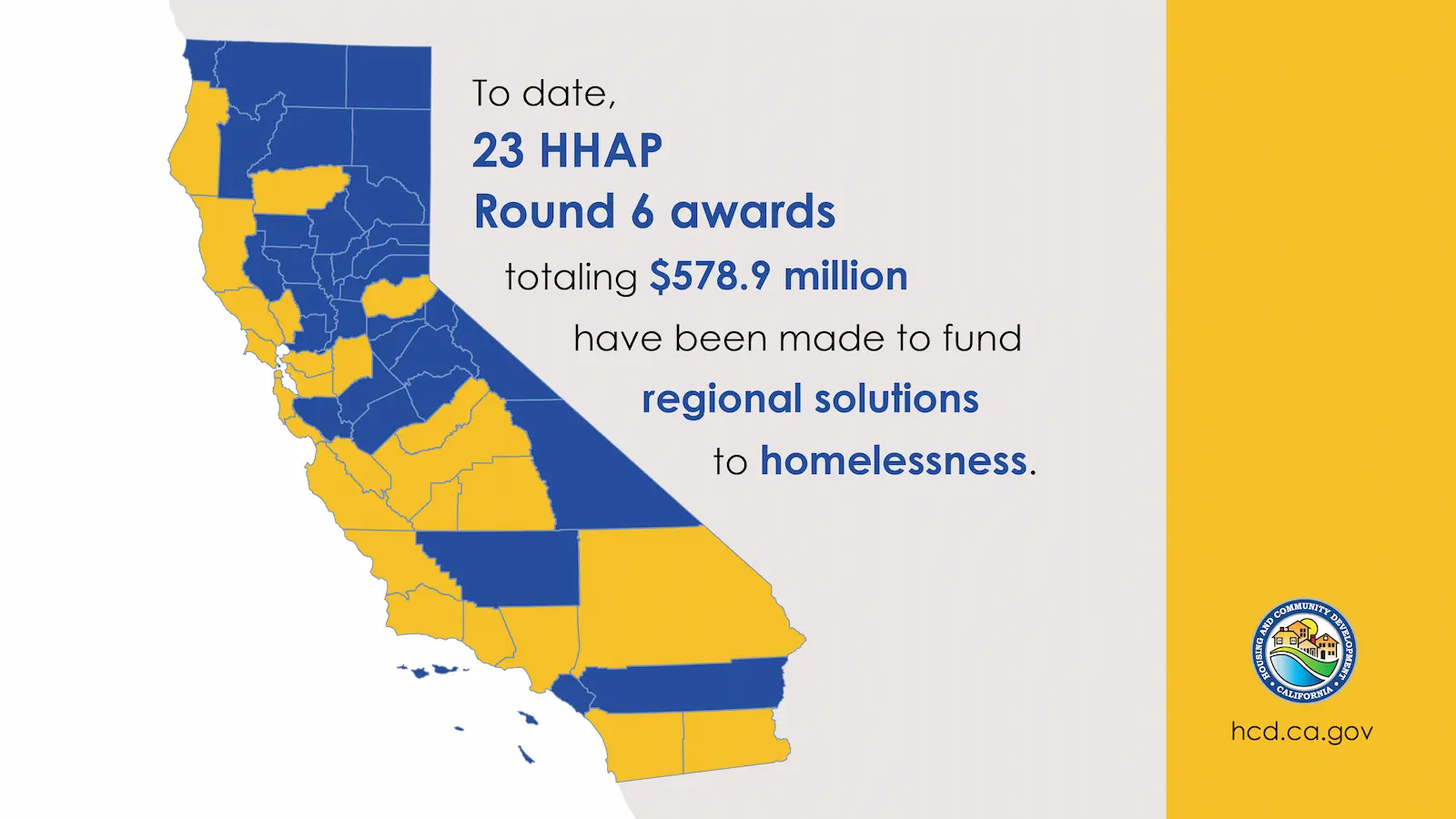
HHAP Grants of $578.9 Million Have Been Made to 23 Regions in Round 6
March 2, 2026
Sacramento, CA
California Governor Gavin Newsom today announced 20 more awards made through Round 6 of the Homeless Housing, Assistance and Prevention (HHAP) program, providing more than $159.3 million to support collaborative regional solutions to homelessness across the state.
HHAP is a critical state investment that has played a role in achieving a projected nine-percent statewide reduction in unsheltered homelessness. The program aims to prevent and end homelessness through regional collaboration on local, targeted solutions. HHAP is a multi-year grant available to California’s 58 counties, 14 large cities (population over 300,000), and 44 Continuums of Care (CoCs) to fund solutions that create permanent housing, sustain interim housing, and accelerate proven local interventions.
“HHAP grants provide essential funding that help local regions collaborate to expand housing opportunities and scale programs that are proven to reduce homelessness,” said California Business, Consumer Services and Housing Agency Secretary Tomiquia Moss. “Across multi-year funding rounds, the cumulative results of these efforts are bringing stability and hope to so many vulnerable Californians in a time when it matters most.”
The HHAP Round 6 awards announced today for 20 regions—Alameda, Contra Costa, El Dorado, Fresno and Madera, Humboldt, Imperial, Kings and Tulare, Marin, Mendocino, Monterey and San Benito, Napa, San Bernardino, San Joaquin, San Luis Obispo, San Mateo, Santa Barbara, Santa Cruz, Sonoma, Tehama, and Ventura—signify these applicants have met HCD’s rigorous review and demonstrated the actions funded through their awards will make tangible impacts on homelessness. Collectively, the grantees in these 20 regions are dedicating 83 percent of their HHAP Round 6 budgets to permanent and interim housing.
In each HHAP region, counties, cities, and CoCs were required to work together on joint applications—explicitly committing to coordinating with each other and clearly stating who is responsible for which parts of their joint regional homelessness efforts. The aim is to drive regional collaboration and make sure homelessness is addressed with all the tools available to the multiple jurisdictions in each HHAP region.
“Through the Newsom Administration’s investment in HHAP, HCD is funding proven, collaborative local solutions to homelessness at a scale never before possible,” said HCD Director Gustavo Velasquez. “We will continue to work with the remaining applicants to help them finalize a robust plan that meets the criteria for award.”
HHAP Round 6 builds on enhanced accountability measures established in Round 5—the first round administered by HCD—and responds to the Governor’s call to ensure funds have the greatest impact for Californians experiencing homelessness. All funded activities are tied to and monitored under standardized metrics that track progress— such as the number of people who are able to move into permanent housing—at the regional level.
Alameda County, the City of Oakland, and the Oakland-Berkeley-Alameda County CoC will receive just over $45.3 million through HHAP Round 6. The Alameda region will allocate the majority of their HHAP 6 funds for interim and permanent housing solutions, notably to operating and maintaining navigation centers, providing operating expenses for existing interim and permanent housing, including for transitional age youth, and funding permanent housing services and service coordination. The Alameda region will also use HHAP 6 to fund a number of rental subsidy and rapid rehousing programs.
Contra Costa County and the Richmond/Contra Costa County CoC will receive approximately $6.7 million through HHAP Round 6. The Contra Costa region will use the funds to sustain critical existing interim housing programs, providing ongoing services and operating expenses for a number of emergency shelters. The region will also provide prevention and diversion services for up to 180 individuals, rapid rehousing for up to 15 transitional age youth, and sustain existing transitional housing services at Pomona Apartments for three years for young adults experiencing homelessness.
El Dorado County and the El Dorado CoC will receive $670,181 through HHAP Round 6. The El Dorado region will use the funds to support operations for a 60-bed navigation center, youth emergency shelters and transitional housing, as well as support prevention, diversion services, case management, and navigation services for homeless youth. The region will also allocate funding to support permanent housing and rapid rehousing programs.
Fresno County, Madera County, the City of Fresno, and the Fresno City & County/Madera County Coc will receive nearly $20.7 million through HHAP Round 6. The Fresno and Madera region will use the grant to support the continued operation of existing interim housing, rapid rehousing programs, prevention and diversion programs, and street outreach services.
Humboldt County and the Humboldt County CoC will receive more than $3.7 million through HHAP Round 6. The Humboldt region will allocate the funds to support operating expenses for permanent housing, including Homekey projects, rental subsidies, supportive services and landlord incentives such as security deposits, holding fees, and funding for needed repairs.
Imperial County and the Imperial County Coc will receive more than $3.5 million through HHAP Round 6. The Imperial region grant will help support rapid rehousing programs, rental subsidies, prevention and diversion programs, motel/hotel vouchers, and existing permanent housing services and services coordination.
Kings County, Tulare County, and the Visalia/Kings Tulare Coc will receive more than $3.9 million through HHAP Round 6. The Kings and Tulare region will allocate funds to support the operation of five of the region’s interim housing sites. The award will also help support youth rapid rehousing and rental subsidies, motel/hotel vouchers, case management, tenancy support, and service coordination services and the Transitional Housing Program - Plus for King and Tulare counties.
Marin County and the Marin County Coc will receive nearly $2.6 million through HHAP Round 6. The Marin region will allocate the majority of their award to fund existing permanent housing case management services and support rental subsidies and rapid rehousing programs. The region will also use the funds to support operating expenses, including case management, for youth transitional housing facilities and existing interim housing sites.
Mendocino County and the Mendocino County Coc will receive more than $1.8 million through HHAP Round 6. The Mendocino region will use the grant to fund operating expenses to congregate emergency shelters using the Housing First model, including shelters that serve families with minor children and unaccompanied youth.
Monterey County, San Benito County, and the Salinas/Monterey, San Benito Counties CoC will receive more than $7.2 million through HHAP Round 6. The Monterey and San Benito region will use the funds to support existing low barrier navigation centers and permanent housing, including for Homekey projects. The grant will also help fund affordable permanent housing projects, operating expenses for existing interim housing, time-limited rental assistance, youth hotel vouchers, housing navigation, and problem-solving and diversion support with case management services.
Napa County and the Napa City and County Coc will receive nearly $1 million through HHAP Round 6. The Napa region will allocate funds to provide rapid rehousing/rental subsidies, and support permanent housing services, homelessness service coordination and the City of Napa’s prevention and diversion program.
San Bernardino County and the San Bernardino City & County CoC will receive $10 million through HHAP Round 6. The San Bernardino region will use its grant to convert underutilized buildings and existing interim housing into permanent housing. Additional funds will go toward permanent housing operating subsidies, street outreach, intensive case management services, housing navigation, harm reduction services, rental subsidies, security deposits, and other support programs that prevent homelessness and support people experiencing homelessness.
San Joaquin County, the City of Stockton, and the Stockton/San Joaquin County CoC will receive nearly $22.7 million through HHAP Round 6. The San Joaquin region will use its grant to fund ongoing operating costs and housing services for low-barrier, trauma-informed emergency shelter programs and navigation centers. The region will also fund delivery of diversion programs that support individuals at risk of homelessness or recently experiencing homelessness, rapid rehousing, rental assistance vouchers, landlord incentives, and case management services.
San Luis Obispo County and the San Luis Obispo County CoC will receive just under $2.8 million through HHAP Round 6. The San Luis Obispo region will use its grant to sustain shelter case management, housing navigation, and connections to supportive services; provide rental assistance, security deposits, and landlord incentives; and contribute gap financing for the development and renovation of 115 new permanent supportive housing units.
San Mateo County and the Daly City/San Mateo County COC will receive $5 million through HHAP Round 6. The San Mateo region will award will help support operating expenses for the Navigation Center of San Mateo County, a 240-unit non-congregate interim shelter, housing-focused case management services, maintenance, and services coordination. The region will also use the funds to support the operation of a new interim shelter supporting transitional age youth and a rapid rehousing program providing temporary rental subsidies and supportive services for transitional age youth.
Santa Barbara County and the Santa Maria/Santa Barbara CoC will receive just over $5 million through HHAP Round 6. The Santa Barbara region will use its grant to support short- to medium-term rental subsidies, housing navigation, and case management services for households experiencing unsheltered homelessness. The region will also operate and enhance interim housing programs, and prevention and diversion strategies such as problem-solving and conflict mediation, housing search and relocation assistance, and flexible financial support for stable housing.
Santa Cruz County and the Watsonville/Santa Cruz City & County CoC will receive nearly $4.4 million through HHAP Round 6. The Santa Cruz region will use those funds to support safe parking and shelter operations, youth transitional housing, homelessness prevention activities, and permanent housing services while allocating resources to maintain a landlord incentive/risk mitigation fund and a landlord outreach, engagement, and support program.
Sonoma County and the Santa Rosa-Petaluma-Sonoma County CoC will receive close to $6 million through HHAP Round 6. The Sonoma region will fund major renovations to an existing interim shelter site and operating expenses for both congregate and non-congregate shelters, including those that serve youth. The region will also support rental subsidies and landlord incentives, intensive case management, housing navigation, and permanent supportive housing operating subsidies.
Tehama County and the Tehama County Coc will receive $764,573 through HHAP Round 6. The Tehama region will allocate a majority of its award to support two existing emergency shelters. The grant will also help support homelessness prevention services including case management, financial assistance with rental arrears, security deposits, and moving costs and time-limited rental subsidies, direct financial assistance for households experiencing homelessness, and operating expenses for transitional aged youth interim housing.
Ventura County and the Oxnard, San Buenaventura/Ventura County Coc will receive nearly $5.6 million through HHAP Round 6. The Ventura region will allocate a majority of the grant funds to support permanent housing solutions, including rapid rehousing funding, ongoing rental assistance subsidies, supportive services, and acquisition, rehabilitation, and maintenance of permanent housing units, Homekey projects and other developments. The region will also fund prevention and diversion services, interim housing operating expenses and motel vouchers for youth experiencing unsheltered homelessness.
The Newsom Administration has made an historic investment in regional solutions to homelessness through multiple rounds of HHAP. With the awards announced today, 23 of 42 regional applications submitted for HHAP Round 6 have been granted more than $578.9 million. HCD is working closely with the remaining 19 regional applicants to address outstanding issues and meet application thresholds, making additional awards on a rolling basis.
There is a HHAP Round 7 totaling $500 million in General Fund planned for FY 2026-27, contingent on enhanced accountability and performance requirements. HHAP Round 7 will build on existing accountability metrics to ensure grantees make meaningful investments in housing solutions and adopt housing policies that will increase downstream housing supply, a critical tool in preventing future homelessness.
Reversing decades of inaction on homelessness
Governor Newsom is creating a structural and foundational model for America:
✅ Creating shelter and support — Providing funding and programs for local governments, coupled with strong accountability measures to ensure that each local government is doing its share to build housing, and create shelter and support, so that people rescued from encampments have a safe place to go. This week, through a $77 million investment from California’s cap and invest program, Los Angeles announced the expansion and redevelopment of the largest public housing project in the region, the Jordan Downs Project.
✅ Addressing mental health and its impact on homelessness — Ending a long-standing 7,000 behavioral health bed shortfall in California by rapidly expanding community treatment centers and permanent supportive housing units. In 2024, voters approved Governor Newsom’s Proposition 1 which is transforming California’s mental health systems. When fully awarded, funding from Proposition 1 bonds is estimated to create 6,800 residential treatment beds and 26,700 outpatient treatment slots for behavioral health care.
✅ Creating new pathways for those who need the most help — Updating conservatorship laws for the first time in 50 years to include people who are unable to provide for their personal safety or necessary medical care, in addition to food, clothing, or shelter, due to either severe substance use disorder or serious mental health illness. Creating a new CARE court system that creates court-ordered plans for up to 24 months for people struggling with untreated mental illness, and often substance use challenges.
✅ Streamlining and prioritizing building of new housing — Governor Newsom made creating more housing a top state priority for the first time in history. He has signed into law groundbreaking reforms to break down systemic barriers that have stood in the way of building the housing Californians need, including broad CEQA reforms.
✅ Removing dangerous encampments — Governor Newsom has set a strong expectation for all local governments to address encampments in their communities and help connect people with support. In 2024, Governor Newsom filed an amicus brief with the Supreme Court defending communities' authority to clear encampments. After the Supreme Court affirmed local authority, Governor Newsom issued an executive order directing state entities and urging local governments to clear encampments and connect people with support, using a state-tested model to address encampments humanely and provide people with adequate notice and support.
In 2025, just a year after he issued an executive order urging local governments to better address encampments, the Governor announced his SAFE Task Force to address encampments in California’s ten largest cities. In just a few months, the task force has addressed encampments in San Francisco, Los Angeles, Long Beach, Sacramento, and Fresno — connecting dozens of people with shelter. Since 2021, Caltrans has removed more than 19,000 encampments on state right-of-way and collected approximately 354,000 cubic yards of litter and debris.