
Prop. 1 continues to create affordable homes for Californians with behavioral health challenges, including our veterans
Homekey+ program has funded 2,260 homes for vulnerable Californians
March 2, 2026
Sacramento, CA
Governor Gavin Newsom today announced another eight affordable housing communities funded through the state’s Homekey+ program, creating 443 additional homes with on-site managers for Californians, including veterans, who are experiencing or at risk of homelessness and living with behavioral health challenges. The program—modeled on the Governor’s highly successful Homekey program and administered by the California Department of Housing and Community Development (HCD)—is part of a comprehensive Newsom Administration strategy to address California’s housing crisis, which has resulted in a projected nine-percent drop in unsheltered homelessness.
With today’s awards, Homekey+ has so far allocated $767.9 million to support 45 permanent supportive housing projects that will create 2,260 affordable homes throughout California for those most in need. Of these homes, 545 are reserved for veterans experiencing or at risk of homelessness with behavioral health challenges.
Across three rounds of the original Homekey program, HCD awarded more than $3.6 billion to fund 261 projects with 15,962 homes expected to house more than 175,000 Californians over the projects’ lifetimes.
More than 1.2 million adults in California live with a serious mental illness, and 1 in 10 residents meet the criteria for a substance use disorder. Voter-approved Proposition 1 of 2024 is transforming California’s mental health systems with a $6.4 billion Behavioral Health Bond for housing, services, and treatment for veterans and others experiencing homelessness. When fully awarded, Prop. 1 bonds are estimated to fund 6,800 residential treatment beds and 26,700 outpatient treatment slots for behavioral health.
Approximately $1.033 billion in Proposition 1 bond funds are currently available through Homekey+ to cities, counties, housing authorities, and tribal entities for permanent supportive housing projects serving veterans. Another $1.11 billion is available for projects serving all target populations, through a combination of Proposition 1 bond funds and Homeless Housing, Assistance, and Prevention program funds.
“Homekey+ and Proposition 1 programs continue to expand the availability of affordable homes and vital supportive services for Veterans and Californians who are experiencing homelessness and living with behavioral health challenges,” said Business, Consumer Services and Housing Agency Secretary Tomiquia Moss. “The supportive housing projects being awarded today will greatly improve lives and ensure that they have a home where they can thrive.”
“These new Homekey+ projects are helping turn the promise we make to our veterans into something tangible: a place to heal, rebuild, and belong,” said CalVet Secretary Lindsey Sin. “This work reflects California’s deep commitment to those who served, and the strength of our partnerships in delivering real solutions. We are proud to stand alongside the Department of Housing and Community Development and communities across the state in this work. Every new Homekey+ project brings us closer to a future where every veteran has the stability, dignity, and support they deserve.”
“HCD is proud to work in partnership with the Governor and CalVet to build a foundation of support for veterans and others who are struggling with addiction and mental health,” said HCD Director Gustavo Velasquez. “As this program and its impacts continue to grow statewide, California will accelerate its hard-fought progress toward preventing and ending homelessness.”
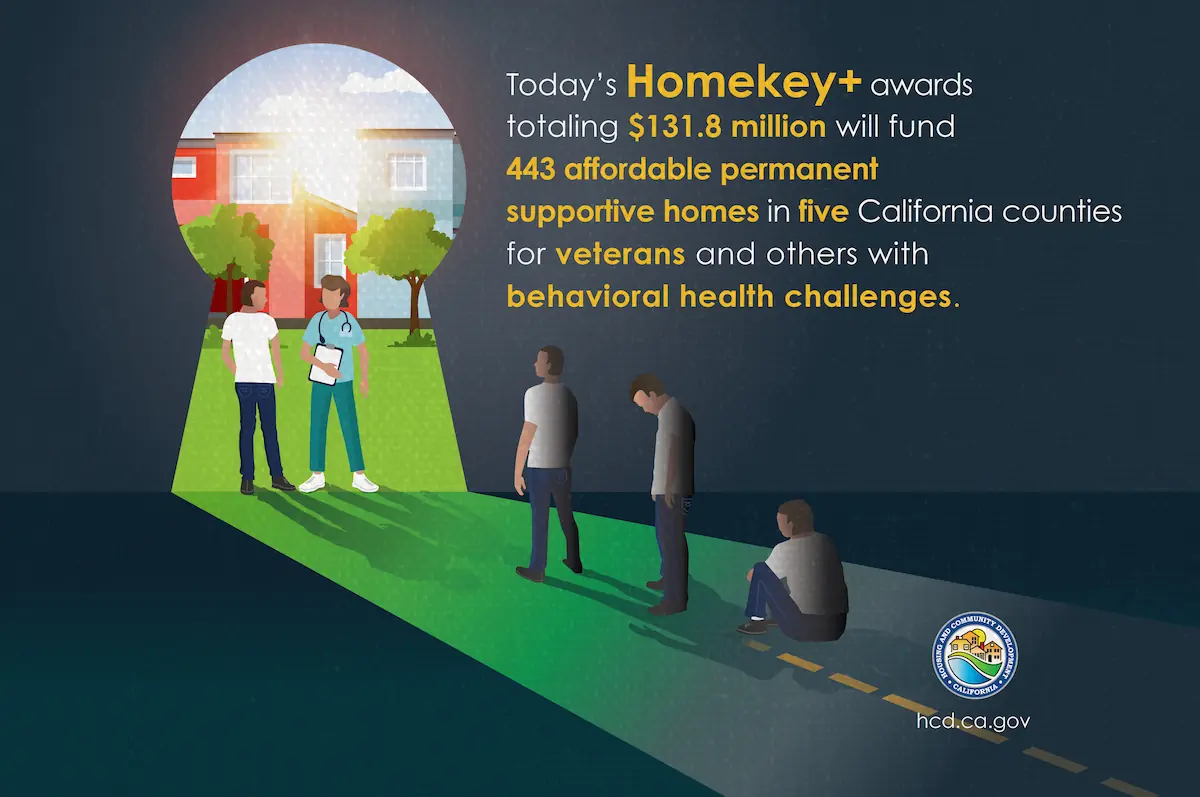
The Homekey+ awards announced today total $131.8 million to create 443 homes across eight projects, with 91 units for veterans and seven manager units:
- The City of Stockton—in partnership with Service First of Northern California—will receive nearly $35.6 million for The Hunter House, a 120-unit permanent supportive housing community. The award will support 77 Homekey+ units at the broader project, with 32 of those units reserved for veterans experiencing homelessness and 10 units for youth at risk of or experiencing homelessness with a behavioral health challenge, as well as one manager unit. HCD previously awarded the project more than $2.5 million from the Infill Infrastructure Grant (IIG) program, as well as $17.2 million from the Affordable Housing and Sustainable Communities program jointly administered by HCD and the California Strategic Growth Council. Local funding of approximately $4.8 million has been committed to the project.
- The County of Tehama—in partnership with Pacific West Communities, Inc., and the Central Valley Coalition for Affordable Housing—will receive just under $11.7 million for The Bluffs Community Housing, consisting of 26 homes for individuals experiencing homelessness with a behavioral health challenge and one manager unit. The project also has $2.7 million in funding from HCD’s No Place Like Home Program. The Bluffs Community Housing received a land donation of $720,000 and a 20-year commitment of Section 8 rental subsidies of approximately $7 million from Plumas County Community Development Commission.
- The County of Yuba—in partnership with Habitat for Humanity Yuba/Sutter, Inc.—will receive more than $5.2 million for Innovation Housing Estates, a 13-unit new construction project to create 12 homes for veterans at risk of homelessness with a behavioral health challenge, as well as one manager unit. The project has committed funds from both local and private sources totaling nearly $1.3 million.
- Contra Costa County will receive $1.5 million for the Sherman Terrace project, creating five homes for people experiencing homelessness with a behavioral health challenge. Contra Costa Behavioral Health Services will operate the site and provide robust supportive services. The property is situated in a quiet, welcoming residential neighborhood in Pleasant Hill.
- The Housing Authority of the City of Los Angeles—in partnership with Housing Opportunity for Angelenos, Inc.—will receive $2.4 million for Maycrest Apartments, a project to convert four bungalow-style buildings into eight permanent supportive homes through a complete renovation that includes significant structural repairs. The neighborhood has many vital amenities, including a grocery store, community clinic, pharmacies, and a park within one mile of the property, as well as a bus stop directly in front of the property.
- The County of Los Angeles—in partnership with TPC Homes and The People Concern—will receive $38.5 million to acquire and convert non-residential structures into 172 homes. The St. Vincent Supportive Community will dedicate five units to veterans at risk of homelessness with a behavioral health challenge, in addition to two manager units. Local funds totaling $20.7 million and project-based subsidies in the amount $23.3 million have also been committed.
- The County of Los Angeles—in partnership with PATH Ventures—will receive nearly $15.7 million to acquire a newly constructed multifamily project. PATH Villas South Park will consist of 51 units for people experiencing homelessness with a behavioral health challenge, as well as one manager unit. The four-story apartment building includes a community room, offices for onsite supportive services and property management, and laundry facilities. PATH Villas South Park is located near a rapid transit bus stop, a grocery store, medical clinic, and pharmacy.
- The City of Santa Fe Springs—in partnership with Affordable Living of the Aging and Primestor Development, LLC—will receive nearly $21.2 million for Santa Fe Springs Village in Los Angeles County, an 88-unit project that dedicates 42 homes to veterans experiencing chronic homelessness with a behavioral health challenge, as well as one manager unit. HCD also awarded this project nearly $2.5 million through the IIG program. The project also received federal funds, various local funds, and a private loan totaling more than $20 million. Project-based rental subsides have been committed for 20 years in the amount of $33.7 million.
The Homekey+ NOFA allocates funding by region based on a proportionate share of veterans and others experiencing homelessness, and by share of extremely low-income households whose rent is more than half of their income. There are also allocations for rural projects and for projects serving youth experiencing or at risk of homelessness. Homekey+ applications will continue to be reviewed and approved on a rolling basis.
Reversing decades of inaction on homelessness
Governor Newsom is creating a structural and foundational model for America:
✅ Creating shelter and support — Providing funding and programs for local governments, coupled with strong accountability measures to ensure that each local government is doing its share to build housing, and create shelter and support, so that people rescued from encampments have a safe place to go. This week, through a $77 million investment from California’s cap and invest program, Los Angeles announced the expansion and redevelopment of the largest public housing project in the region, the Jordan Downs Project.
✅ Addressing mental health and its impact on homelessness — Ending a long-standing 7,000 behavioral health bed shortfall in California by rapidly expanding community treatment centers and permanent supportive housing units. In 2024, voters approved Governor Newsom’s Proposition 1 which is transforming California’s mental health systems. When fully awarded, funding from Proposition 1 bonds is estimated to create 6,800 residential treatment beds and 26,700 outpatient treatment slots for behavioral health care.
✅ Creating new pathways for those who need the most help — Updating conservatorship laws for the first time in 50 years to include people who are unable to provide for their personal safety or necessary medical care, in addition to food, clothing, or shelter, due to either severe substance use disorder or serious mental health illness. Creating a new CARE court system that creates court-ordered plans for up to 24 months for people struggling with untreated mental illness, and often substance use challenges.
✅ Streamlining and prioritizing building of new housing — Governor Newsom made creating more housing a top state priority for the first time in history. He has signed into law groundbreaking reforms to break down systemic barriers that have stood in the way of building the housing Californians need, including broad CEQA reforms.
✅ Removing dangerous encampments — Governor Newsom has set a strong expectation for all local governments to address encampments in their communities and help connect people with support. In 2024, Governor Newsom filed an amicus brief with the Supreme Court defending communities' authority to clear encampments. After the Supreme Court affirmed local authority, Governor Newsom issued an executive order directing state entities and urging local governments to clear encampments and connect people with support, using a state-tested model to address encampments humanely and provide people with adequate notice and support.
In 2025, just a year after he issued an executive order urging local governments to better address encampments, the Governor announced his SAFE Task Force to address encampments in California’s ten largest cities. In just a few months, the task force has addressed encampments in San Francisco, Los Angeles, Long Beach, Sacramento, and Fresno — connecting dozens of people with shelter. Since 2021, Caltrans has removed more than 19,000 encampments on state right-of-way and collected approximately 354,000 cubic yards of litter and debris.