
On Eve of LA Fire Anniversary, Governor Newsom Announces Housing Push to Keep Survivors in Their Communities
January 6, 2026
What you need to know: Less than a year after devastating wildfires, the Newsom Administration has funded nearly one thousand new affordable rental homes in Los Angeles communities through programs that cut red tape, save time and money, and build faster. These homes will help fire survivors and other local residents stay in their communities.
January 6, 2026
Sacramento, CA
On the eve of the anniversary of the 2025 Los Angeles fires, Governor Gavin Newsom announced new investments in affordable housing across Los Angeles County to help survivors rebuild their lives by creating more affordable housing in communities in the region. These investments will help keep current residents housed and prevent displacement without changing local zoning rules or neighborhood character.
“We are rebuilding stronger, fairer communities in Los Angeles without displacing the people who call these neighborhoods home. More affordable homes across the county means survivors can stay near their schools, jobs, and support systems, and all Angelinos are better able to afford housing in these vibrant communities,” said Governor Gavin Newsom.
Supporting Survivors and Veterans and Preserving Communities
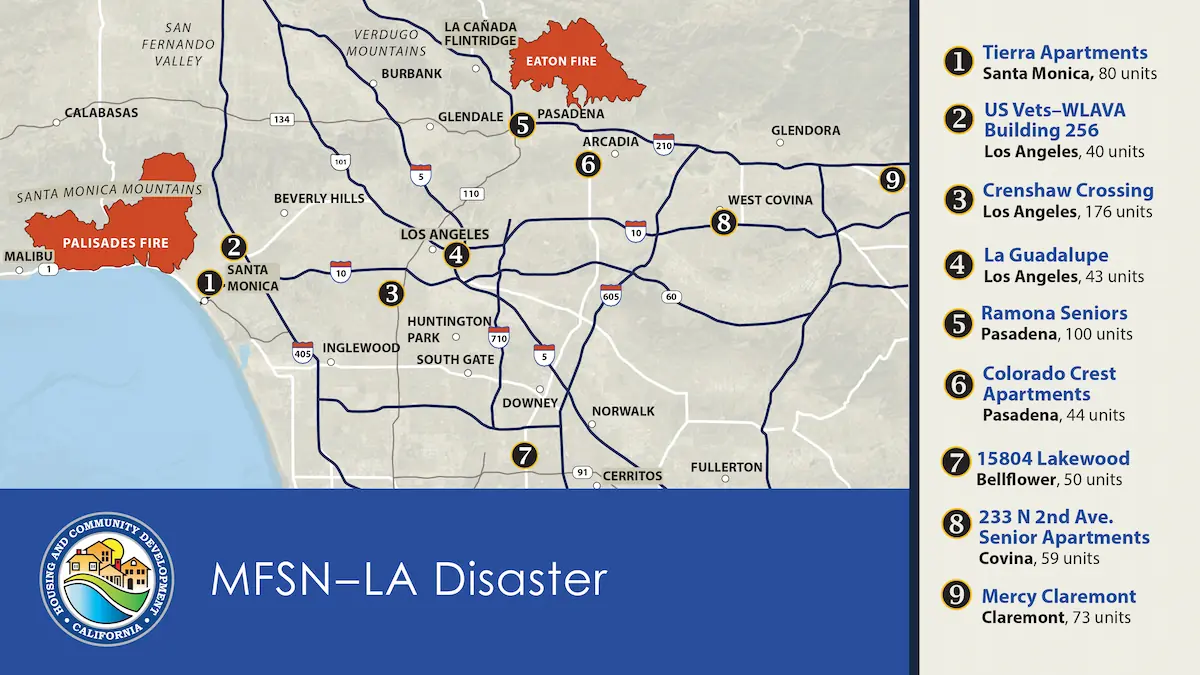
The state announced today that $107.3 million from a Multifamily Finance Super NOFA (MFSN-LA Disaster) specifically for communities impacted by fire will fund nine projects with 673 new affordable rental homes. These projects do not change local planning, zoning, and design standards, including existing rules on height, setbacks, parking, and wildfire safety. None of these projects are in the burn scar areas and they will not replace destroyed homes. Rather, the projects are located in the Los Angeles County cities of Los Angeles, Bellflower, Claremont, Covina, Santa Monica, and Pasadena. By creating affordable homes in multiple communities across the county, the state is instead relieving the pressure on housing supply without concentrating all new housing in the burn areas.
New affordable homes will be offered first to survivors and other eligible residents through occupancy preferences and priority policies tailored to people displaced by the 2025 fires. The Governor has also issued and expanded executive actions that prioritize fire survivors on affordable housing waitlists and protect them from suddenly losing shelter as temporary assistance and insurance payouts run out.
In addition, the affordable rental housing developments awarded today will include 29 homes reserved for veterans. These homes for veterans are in addition to the 87 veteran units funded through MFSN Round 3 and 454 veteran units announced so far through the California Department of Housing and Community Development's (HCD) Homekey+ program.
Keeping survivors housed without displacement
Just under a year since the Palisades and Eaton fires devastated Los Angeles communities and displaced thousands of families, the state remains focused on stability and long-term recovery for survivors. Many families are still struggling with a tight rental market, and rising costs, this effort is aimed at making it possible for them to remain in Los Angeles County close to work, school, and support networks.
When HCD announced funding availability for Round 3 of MFSN in February 2025, the Department shared it would develop a separate NOFA for disaster-impacted areas informed by consultation with fire-impacted communities and other stakeholders—to support recovery and rebuilding from the unprecedented Southern California wildfire destruction. California’s Multifamily Finance Super NOFA for Los Angeles disaster-impacted areas allows developers in local jurisdictions to request funding from multiple state housing programs through a single application, cutting red tape and speeding up delivery of new affordable homes.
The broader, statewide MFSN awards announced by HCD in September 2025 included nearly $56.9 million for four projects with 301 affordable rental homes in Los Angeles County. With awards today, there is a total of 974 much-needed new affordable homes on the horizon for Los Angeles through MFSN Round 3 and MFSN-LA Disaster.
“Los Angeles residents faced a tight rental housing market even before these unprecedented wildfires forced thousands from their homes and compounded the problem,” said California Business, Consumer Services and Housing Agency Secretary Tomiquia Moss. “This Administration has used every tool at its disposal to support Los Angeles jurisdictions as they navigate long-term recovery, and these new affordable homes will help nearly a thousand households obtain stable housing.”
“HCD continues to prioritize fire survivors at our properties throughout the Los Angeles region, and we look forward to seeing these additional homes brought to completion as soon as possible,” said HCD Director Gustavo Velasquez. “We are proud to support this Administration in its focused efforts to help residents find stability in the face of unimaginable tragedy.”
A countywide strategy to relieve pressure and protect neighborhoods
Los Angeles County’s housing crisis is regional, and wildfires have added pressure on already scarce homes. Building more affordable housing across the county helps teachers, nurses, first responders, service workers, veterans, and fire survivors remain part of the communities they serve. In practical terms, more affordable homes mean less bidding wars for every available unit, more stability for current residents, and less risk that families will be forced out of Los Angeles County altogether.
California’s investments are aimed at a straightforward goal that residents can see and feel: helping survivors and local families stay rooted in their neighborhoods, while protecting the character of communities from the Palisades to the San Gabriel Valley.
Visit HCD online for more information about the MFSN-LA Disaster awards.
A housing approach that works
From the very first moments of the Newsom administration, the national crisis of housing and homelessness – which were decades in the making – has been addressed with ingenuity, seriousness, and expertise. No other state has devoted as much time and attention to these twin problems – and California is a leader in producing positive results. Governor Newsom is creating a structural and foundational model for America:
✅ Addressing mental health and its impact on homelessness — Ending a long-standing 7,000 behavioral health bed shortfall in California by rapidly expanding community treatment centers and permanent supportive housing units. In 2024, voters approved Governor Newsom’s Proposition 1 which is transforming California’s mental health systems with a $6.4 billion Behavioral Health Bond for treatment settings and housing with services for veterans and people experiencing homelessness, and reforming the Behavioral Health Services Act to focus on people with the most serious illnesses, provide care to people with substance disorders, and support their housing needs.
✅ Creating new pathways for those who need the most help — Updating conservatorship laws for the first time in 50 years to include people who are unable to provide for their personal safety or necessary medical care, in addition to food, clothing, or shelter, due to either severe substance use disorder or serious mental health illness. Creating a new CARE court system that creates court-ordered plans for up to 24 months for people struggling with untreated mental illness, and often substance use challenges.
✅ Streamlining and prioritizing building of new housing — Governor Newsom made creating more housing a top state priority for the first time in history. He has signed into law groundbreaking reforms to break down systemic barriers that have stood in the way of building the housing Californians need, including broad CEQA reforms.
✅ Creating shelter and support — Providing funding and programs for local governments, coupled with strong accountability measures to ensure that each local government is doing its share to build housing, and create shelter and support, so that people rescued from encampments have a safe place to go.
✅ Removing dangerous encampments — Governor Newsom has set a strong expectation for all local governments to address encampments in their communities and help connect people with support. In 2024, Governor Newsom filed an amicus brief with the Supreme Court defending communities' authority to clear encampments. After the Supreme Court affirmed local authority, Governor Newsom issued an executive order directing state entities and urging local governments to clear encampments and connect people with support, using a state-tested model to address encampments humanely and provide people with adequate notice and support.
Reversing a decades-in-the-making crisis
The Newsom administration is making significant progress in reversing decades of inaction on homelessness. Between 2014 and 2019—before Governor Newsom took office—unsheltered homelessness in California rose by approximately 37,000 people. Since then, under this Administration, California has significantly slowed that growth, even as many other states have seen worsening trends.
In 2024, while homelessness increased nationally by over 18%, California limited its overall increase to just 3% — a lower rate than in 40 other states. The state also held the growth of unsheltered homelessness to just 0.45%, compared to a national increase of nearly 7%. States like Florida, Texas, New York, and Illinois saw larger increases both in percentage and absolute numbers. California also achieved the nation’s largest reduction in veteran homelessness and made meaningful progress in reducing youth homelessness.