
Governor Newsom delivers $111 million in voter-approved Prop 1 funding to communities to get people off the streets and connected to mental health care
To date, Homekey+ has created 50 supportive housing projects with 2,471 affordable homes —including 620 homes for veterans
What you need to know: Governor Newsom today announced the award of $111 million of voter-approved Proposition 1 funding to create six new affordable housing communities across the state – helping to house and support thousands of people, including veterans and people with behavioral health needs.
May 12, 2026
Sacramento, CA
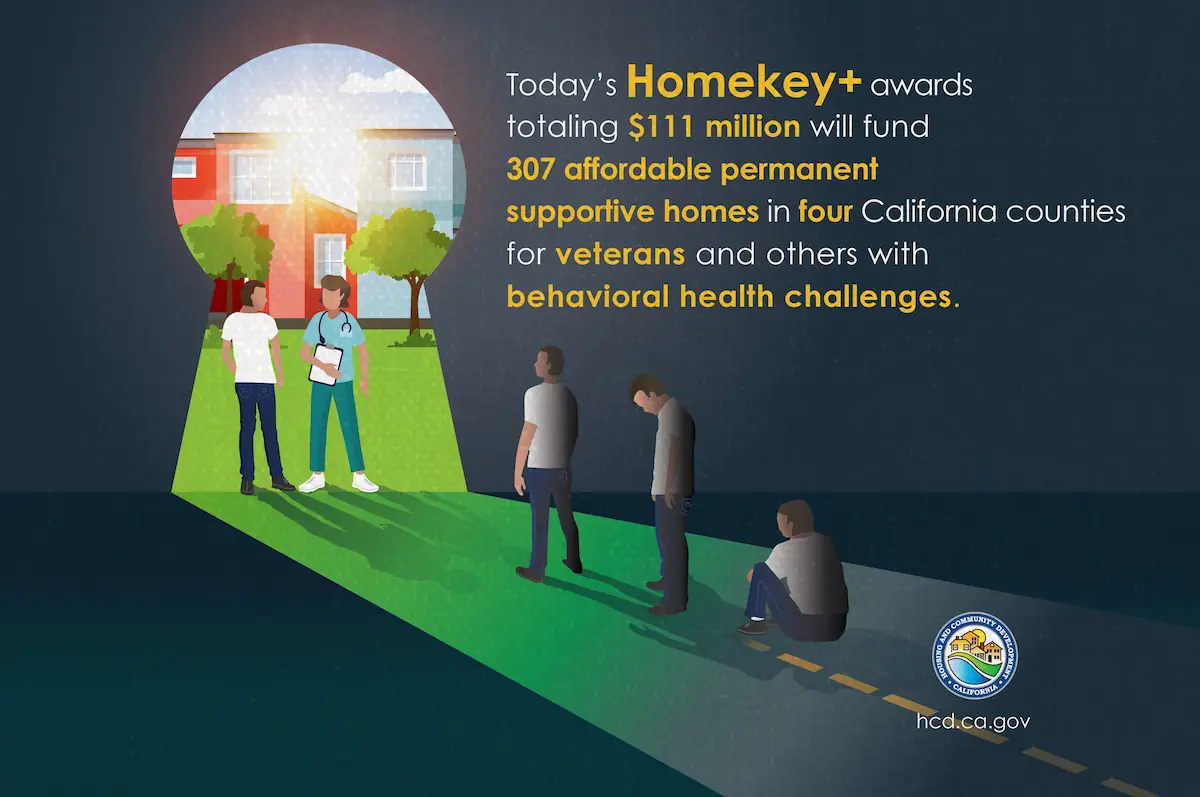
Building on California’s strategies leading to a 9% reduction of unsheltered homelessness last year, Governor Gavin Newsom today announced the award of voter-approved Proposition 1 funding to create another six affordable housing communities. The communities are part of the state’s Homekey+ program to expand supportive housing and behavioral health services statewide. Today’s announcement creates 307 new permanent supportive homes to provide stability for veterans and other Californians who are experiencing or at risk of homelessness and living with behavioral health challenges.
“Our state investments have launched critical programs for local communities to help get vulnerable people off the streets and into housing and care. Together, we’re breaking cycles of homelessness that took decades to create — and we’re doing it with urgency, compassion, and accountability,” said Governor Gavin Newsom.
Governor Newsom is the first governor to have prioritized new housing, homeless, and mental health programs, and is turning around the impacts of this national crisis impacting California, leading the first reduction in unsheltered homelessness in more than 15 years.
More than 1.2 million adults in California live with a serious mental illness, and 1 in 10 residents meet the criteria for a substance use disorder, greatly increasing their odds of experiencing homelessness.
Proposition 1, advanced by the Governor in partnership with the Legislature and approved by voters in 2024, helps local communities provide vital care and housing for these vulnerable residents. Prop 1 is transforming California’s behavioral health systems with a $6.4 billion Behavioral Health Bond for housing, services, and treatment for veterans and people experiencing homelessness, including $2.25 billion through Homekey+ to serve individuals with mental health or substance use challenges and veterans.
“Proposition 1 and Homekey+ funds are supporting communities throughout California by investing in affordable homes with supportive services,” said Business, Consumer Services and Housing Agency Secretary Tomiquia Moss. “The homes created through today’s awards will provide stability and dignity to Californians most in need.”
With today’s awards, Homekey+ has so far allocated $858.8 million to support 50 permanent supportive housing projects that will create 2,471 affordable homes throughout California for individuals experiencing or at risk of homelessness with behavioral health challenges. Of these homes, 620 are reserved for veterans.
“Each new Homekey+ award means more than housing. It means stability, dignity, and a fresh start for veterans in need,” said CalVet Secretary Lindsey Sin. “With 75 more veterans’ homes in this round, and 620 total veterans’ units across 50 projects, we are seeing the real impact of strong partnerships and a shared commitment to those who served. CalVet is proud to continue working alongside the California Department of Housing and Community Development and local partners to turn these projects into places where veterans can rebuild their lives.”
Approximately $1.033 billion in Proposition 1 bond funds are currently available through Homekey+ to cities, counties, housing authorities, and tribal entities for permanent supportive housing projects serving veterans. Another $1.11 billion is available for projects serving all target populations, through a combination of Proposition 1 bond funds and Homeless Housing, Assistance, and Prevention Program (HHAP) funds.
In addition to supportive affordable housing through Homekey+ and HHAP, through Proposition 1 bonds, the state is also funding 6,800 residential treatment beds and 26,700 outpatient treatment slots for behavioral health.
“HCD is working with CalVet to advance California voters’ vision for a state in which people with mental health challenges have the services and support they need to succeed in a life lived off the streets,” said HCD Director Gustavo Velasquez. “We have reached a point where the numbers are reflecting the cumulative impact of our programs, and we look forward to building on those successes under the soon-to-be California Housing and Homeless Agency.”
The Homekey+ awards announced today total $111 million to create 307 homes across six projects, with 75 units for veterans and six manager units:
- The City of Antioch in partnership with California Supportive Housing, will receive nearly $34.9 million in Homekey+ funds to acquire and rehabilitate a hotel into 85 homes, including one manager’s unit. The project will set aside 21 units for veterans and 21 units for transitional age youth. The development known as CSH Mahogany Housing is conveniently located near two bus stops and a busy commercial area that offers amenities such as a grocery store, pharmacy, restaurants, retail stores, and two major medical centers.
- The City of Cudahy in partnership with National Community Renaissance of California and Prima Development, will receive just under $8 million in Homekey+ funding to fill a financing gap for Amanda Villas. The project will have a total of 140 homes, including two manager’s units. The project dedicates 69 units to individuals experiencing chronic homelessness, 18 of which are designated as Homekey+ units for people facing a behavioral health challenge. In addition to Homekey+ funds, HCD’s Multifamily Finance Super NOFA Program awarded $6.7 million in 2023. Project-based rental subsidies of $33.1 million have been committed by the Los Angeles County Development Authority.
- The County of Fresno, in partnership with UP Holdings California, LLC and RHCB Development LP, will receive just over $27 million in Homekey+ funding for Sendero Commons, a new construction project with 88 homes, including one manager's unit. The project dedicates 45 units to veterans. HCD’s No Place Like Home program awarded $10 million in 2022. The Homekey+ award will fill the financing gap and replace the need for tax credits.
- The Housing Authority of the City of Los Angeles, in partnership with The RightWay Foundation, will receive more than $12.5 million in Homekey+ funding to acquire two newly constructed buildings with a total of 33 homes, including two manager’s units, to serve youth who are experiencing or at risk of homelessness with a behavioral health challenge. All units include a kitchen and private bathroom.
- The City of Los Angeles, in partnership with National Community Renaissance of California, will receive $15.6 million in Homekey+ funding to rehabilitate a motel into Huntington Villas, with 52 homes for individuals experiencing homelessness with a behavioral health challenge and one manager’s unit. The project also has funding and rental subsidy commitments from Los Angeles County.
- The County of Santa Barbara, in partnership with DignityMoves, will receive a Homekey+ award of just over $11.7 million to build the 30-home Calle Real Family Village to serve veterans, youth, and other Californians experiencing or at risk of homelessness, as well as one on-site manager. Nine units are dedicated for veterans, with three of those reserved for veterans aged 18-24. The project will utilize modular units and include indoor and outdoor community spaces. It is located within one-half mile of transportation stops, a medical clinic.
This adds to state investments made by the administration and Legislature since 2019 to help local communities address homelessness, including the launch of the first-in-the-nation Homekey program that has funded nearly 16,000 homes across more than 250 projects that will house an estimated 172,000 Californians over the projects’ lifetimes; $4.95 billion through current and previous rounds of the HHAP Program; $2.2 billion through Homekey+ to serve individuals with mental health or substance use challenges and veterans; $1 billion in Encampment Resolution Funds to provide services and housing to help 23,000 individuals across 120 encampment sites transition from homelessness.
The Homekey+ NOFA allocates funding by region based on a proportionate share of veterans and others experiencing homelessness, and by share of extremely low-income households whose rent is more than half of their income. There are also allocations for rural projects and for projects serving youth experiencing or at risk of homelessness. Homekey+ applications will continue to be reviewed and approved on a rolling basis.
Reversing a decades-in-the-making crisis
From the very first moments of the Newsom administration, California has approached the decades-in-the-making housing and homelessness crisis with focus and urgency. No other state has devoted as much time and attention to these twin problems – and California is a leader in producing positive results. Governor Newsom, in partnership with the Legislature, has continued to make progress in reversing decades of inaction, leading to a 9% reduction in unsheltered homelessness, a first in more than 15 years:
✅ Expanding shelter and support — Providing funding and programs for local governments, coupled with strong accountability measures to ensure that each local government is doing its share to build housing, and create shelter and support, so that people living in encampments have a safe place to go.
✅ Addressing mental health and its impact on homelessness — Ending a long-standing 7,000-bed shortfall in California’s behavioral health system by rapidly expanding community treatment centers and permanent supportive housing units. In 2024, voters approved Governor Newsom’s Proposition 1, which is transforming California’s behavioral health systems. It is estimated that funding from Proposition 1 will create 6,800 residential treatment beds and 26,700 outpatient treatment slots for behavioral health care.
✅ Creating new pathways for those who need the most help — Updating conservatorship laws for the first time in 50 years to include people who are unable to provide for their personal safety or necessary medical care, in addition to food, clothing, or shelter, due to either severe substance use disorder or serious mental health illness. Creating a new CARE court system that creates court-administered plans for up to 24 months to help people struggling with schizophrenia and other psychotic disorders, often with substance use challenges, get the treatment and housing they need to recover and thrive.
✅ Streamlining and prioritizing building of new housing — Governor Newsom made creating more housing a state priority for the first time in history. He has signed into law groundbreaking reforms to break down systemic barriers that have stood in the way of building the housing Californians need, including broad CEQA reforms.
✅ Removing dangerous encampments — Governor Newsom has set a strong expectation for all local governments to address encampments in their communities and help connect people with support. In 2024, Governor Newsom filed an amicus brief with the Supreme Court defending communities’ authority to clear encampments. After the Supreme Court affirmed local authority, Governor Newsom issued an executive order directing state entities and urging local governments to clear encampments and connect people with support, using a state-tested model that helps ensure encampments are addressed humanely and people are given adequate notice and support.