April 2023

DGS and HCD Announce Grand Opening of the First State-Owned Affordable Housing Project to Open Under Governor Newsom’s Executive Order
Off
Sacramento, CA
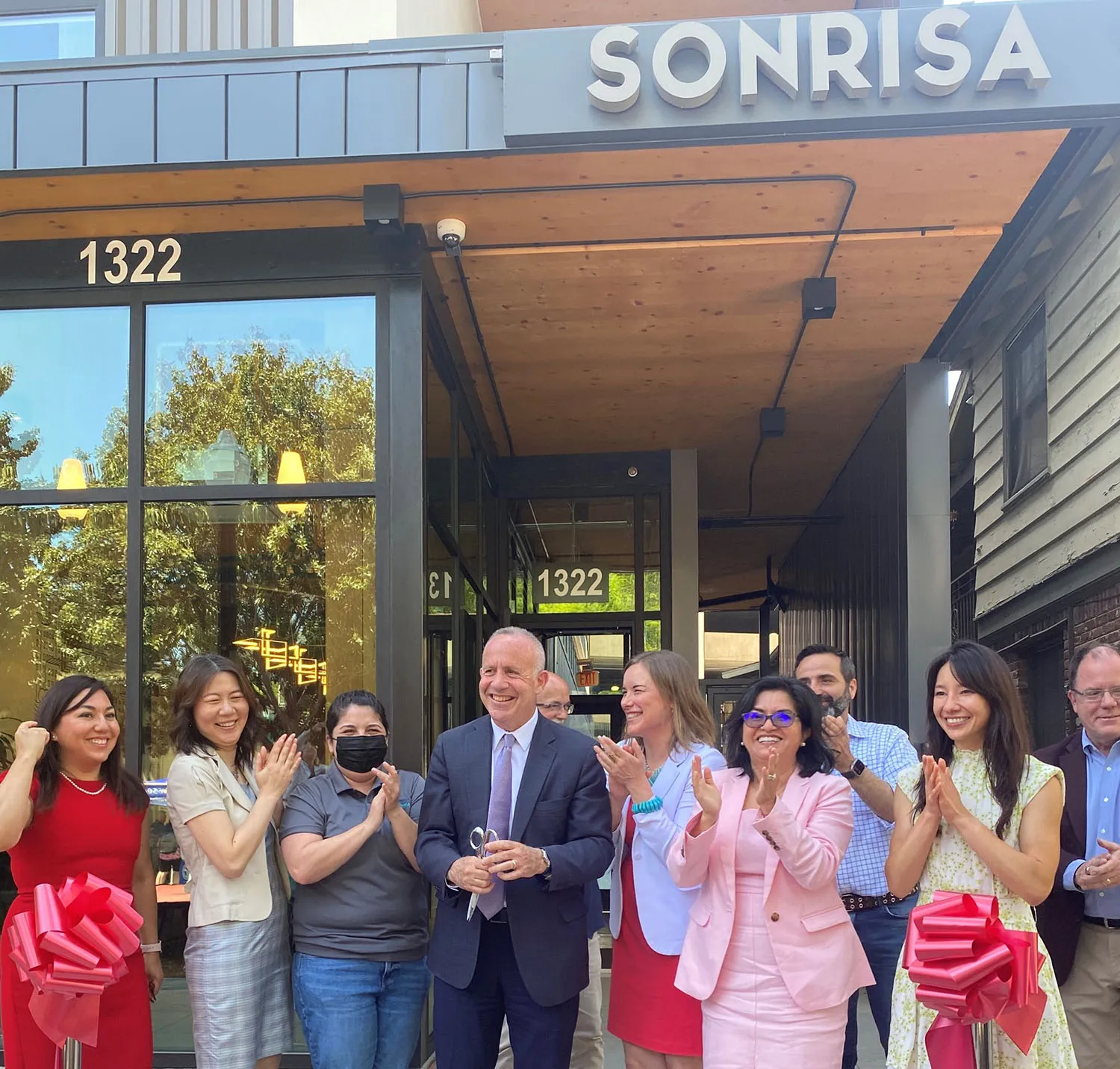
Grand Opening of Sonrisa with Sacramento Mayor Darrell Steinberg


  • An Executive Order signed by Governor Newsom allows for building of affordable housing on excess state land
  • Sonrisa is the first project completed using excess state land, creating housing for nearly 60 residents in the heart of downtown Sacramento
  • Similar efforts are being duplicated throughout the state
  • A Joint Powers Authority between the state and city generated this historic development 

The Department of General Services (DGS), California Department of Housing and Community Development (HCD), and Capitol Area Development Authority (CADA) are pleased to announce the grand opening of Sonrisa, a 58-unit community situated in downtown Sacramento at 1322 O Street. This project was the first to break ground and is the first project finished under Governor Gavin Newsom’s Executive Order N-06-19 for affordable housing development, which prioritizes the identification of excess state-owned property and pursuit of sustainable, innovative, and cost-effective construction methods to increase affordable housing.

“In California, we are using every tool available to build more housing faster, said Governor Newsom. “The grand opening of Sonrisa is a prime example of public and private sectors working together to accelerate the development of affordable housing on excess state-owned land. We are working to duplicate this effort throughout the state – providing more Californians with a place to call home.”

Construction crews broke ground in June 2021 and recently completed Sonrisa, which is located near the Capitol on an underutilized infill site and with exceptional public transit accessibility, walkability, and convenient proximity to jobs and services. 

“Thanks to the Governor’s leadership and vision, this project is a shining example of how state government can change the way it operates to achieve a goal for the greater good”, said California’s Government Operations Secretary Amy Tong. “The pipeline of these projects has just begun and I’m looking forward to seeing continued progress in the months and years ahead so that we’re meeting the needs of all Californians.”

Sonrisa is a zero-net energy, zero-net carbon housing development consisting of 57 micro unit apartments at 267 square feet each, and a manager unit for a total of 58 units, as well as 1,300 square feet of ground floor commercial space that will house a job training center in partnership with the Sacramento Employment and Training Agency (SETA). One hundred percent of the 57 rental units are affordable housing at low and very low-income levels.

“This partnership between the state and Sacramento-- from groundbreaking to grand opening in just under two years-- is a win for residents, businesses, and the downtown community,” said Business, Consumer Services and Housing Agency Secretary Lourdes Castro Ramírez. “By unlocking and making excess state land available for projects like Sonrisa we are producing more affordable, safe, and stable homes and meeting climate and transportation goals. The 63 residents who call Sonrisa home will benefit from proximity to public transit, health care, jobs, shopping, and other amenities.”

“When this program was first conceived, we loved the idea of doing a showcase project just blocks away from the Capitol,” said DGS Director Ana Lasso. “With its dedication to sustainability, including being fully electric, zero-net energy, and the use of engineered cross-laminated timber, Sonrisa exceeded our expectations. We are so proud to see this innovative housing project open.”

Along with the low-cost, long-term ground lease with the state, a competitive Transit-Oriented Development grant from HCD and the state’s Low-Income Housing Tax Credit program will ensure Sonrisa remains an affordable place to call home in perpetuity. 

“Sonrisa is a model of what HCD is working to advance throughout California: Affordable, climate-smart housing that gives low-income residents direct access to public transportation, connecting them to a world of opportunity,” said HCD Director Gustavo Velasquez. “The Governor’s vision to develop excess sites in this manner will have a long-lasting impact, with affordability covenants that are nearly double the most generous of other existing funding models.”

DGS entered into the first long-term ground lease with CADA to make this project possible.

“CADA cultivates community in a variety of ways. At Sonrisa, we have thoughtfully planned common areas for resident use and interaction, incorporated art by local artists within those areas to bring vibrancy and a sense of place, and contracted for a range of on-site services to support resident living experiences and success,” said CADA Executive Director Danielle Foster. “Together with our public sector, development, and nonprofit partners, as well as local advocates, and of course, our residents, CADA intentionally develops neighborhoods for all residents to thrive.” 

Sonrisa is the first ground-up, cross-laminated timber (CLT) project in Sacramento. CLT is a large-scale, prefabricated, solid engineered wood panel product that sequesters carbon in solid form and keeps it from entering the atmosphere as CO2. Carbon sequestration is a key strategy in the fight to address climate change risks. CLT stores more carbon than many alternative non‐wood building materials. CLT is also very strong, with superior fire, seismic and thermal performance, generating almost no waste at a construction site, developing at least 20% faster, and resulting in an estimated 90% less construction traffic to and from the site.

Other sustainable features of the Sonrisa project include: 100% electric ahead of the City of Sacramento’s 2026 requirement; submetered, centralized heat pump water heating and HVAC system; low water demand landscape materials; permeable landscaped area that directs surface stormwater runoff from paved areas to the landscaping to promote infiltration and detention; low volatile organic compound (VOC) building materials; and participation in SMUD programs for use of renewable energy.

More information about Sonrisa can be found here

Williams and Paddon, now 19-6 Architects, architect information can be found here

The Department of General Services acts as the business manager for the state of California. DGS helps state government better serve the public by providing services to state agencies including procurement and acquisition solutions, real estate management, leasing and design services, environmentally friendly transportation, and architectural oversight and funding for the construction of safe schools.

HCD helps to provide stable, safe homes affordable to veterans, seniors, young families, farm workers, tribes, people with disabilities, and individuals and families experiencing homelessness so that Every California resident can live, work, and play in healthy communities of opportunity.


DGS Logo  BCSH Logo  HCD logo

  • Affordable Housing
  • Press Release
  • April 28, 2023
    DGS Public Affairs
    Off
    Article

    California Sues Huntington Beach for Violating State Housing Element Law

    Off
    Sacramento, CA
    City of Huntington Beach


    • The state today filed a motion to amend its March 8 housing lawsuit against Huntington Beach
    • Since California filed its lawsuit, the City of Huntington Beach rescinded its illegal ban on SB 9 and ADU applications but refused to adopt a housing element in violation of state law, jeopardizing affordable housing opportunities for its residents

    Governor Gavin Newsom, Attorney General Rob Bonta, and the California Department of Housing and Community Development (HCD) today filed a motion to amend the state’s lawsuit against Huntington Beach in order to hold the City accountable for violating the state Housing Element Law. California originally filed the lawsuit on March 8, arguing that the city’s ban on the processing of SB 9 and Accessory Dwelling Unit (ADU) applications violated state housing laws and must be struck down. As a result of the state’s lawsuit, the Huntington Beach City Council reversed course and voted on March 21 to resume processing SB 9 and ADU project applications. However, at a meeting on April 4, the City Council once again violated state housing law by failing to adopt a housing element that is 16 months overdue – a decision that jeopardizes critical affordable housing opportunities for Huntington Beach residents.

    Today, the state submitted an amended complaint in People of California v. City of Huntington Beach, arguing that the city is in violation of the state Housing Element Law, and seeking both penalties and injunctive relief. The state also intends to seek temporary relief against the city as authorized by statute, including, among other things, the suspension of the city’s permitting authority and mandating the approval of certain residential projects until the city comes into compliance with the law. Although the state is no longer seeking a preliminary injunction due to the city’s about-face on SB 9 and ADU applications, the amended complaint does also seek a declaration from the court that the city’s previous ban on SB 9 and ADU applications was unlawful and may not be reinstated. 

    “Huntington Beach continues to fail its residents,” said Governor Newsom. “Every city and county needs to do their part to bring down the high housing and rent costs that are impacting families across this state. California will continue taking every step necessary to ensure everyone is building their fair share of housing and not flouting state housing laws at the expense of the community.”

    “California is in the midst of a housing crisis, and time and time again, Huntington Beach has demonstrated they are part of the problem by defiantly refusing every opportunity to provide essential housing for its own residents,” said Attorney General Bonta. “The City’s refusal last week to adopt a housing element in accordance with state law is just the latest in a string of willfully illegal actions by the city – decisions that worsen our housing crisis and harm taxpayers and Huntington Beach residents. We won’t stand idly by as Huntington Beach continues to flagrantly violate state housing laws designed to bring crucial affordable housing opportunities to our communities. We’ll use every legal tool available to hold the city accountable and enforce state housing laws.”

    “More housing is the path to ending and reducing homelessness but Huntington Beach continues to brazenly violate state housing laws--wasting valuable time and tax-payer money instead of working on solutions,” said HCD Director Gustavo Velasquez. “HCD is committed to ensuring every city and county follows state housing laws and fulfills their commitment to building housing for all.”

    State law requires local governments to include housing elements in their general plans. A housing element must include, among other things, an assessment of housing needs, an inventory of resources and constraints relevant to meeting those needs, and a program to implement the policies, goals, and objectives of the housing element. The housing element is a crucial tool for building housing for moderate-, low-, and very low-income Californians. Huntington Beach has been out of compliance on its housing element since October 15, 2021, and last week in a 4-3 vote the City Council once again refused to adopt a draft housing element prepared by the city’s own staff. As a result, the state is seeking injunctive relief and penalties against the city for their ongoing failure to comply with state housing law.

    Furthermore, under California’s Housing Accountability Act, cities that do not have a compliant housing element are subject to the so-called “Builder’s Remedy,” which allows project developers to submit housing projects with deed-restricted 20% low-income or 100% moderate-income without regard to local zoning and general plan standards. Under the Builder’s Remedy provision, localities must approve these low- and moderate-income projects as long as they conform with objective building and design standards and comply with California Environmental Quality Act and the Coastal Act. These laws allow localities to address any specific, legitimate environmental or health and safety concerns on a project-by-project basis. As Huntington Beach remains non-compliant with the state Housing Element Law, the Builder’s Remedy is in effect, and the city must approve Builder’s Remedy projects that meet the legal criteria.

    The city previously attempted to skirt the Builder’s Remedy by proposing an ordinance to ban  Builder’s Remedy projects. On February 13, HCD and the Attorney General warned the city’s planning commission that the proposed ordinance would violate state law. Attorney General Bonta and HCD continue to closely monitor the progress of the proposed ordinance, as well as the city’s actions on any Builder’s Remedy project applications submitted to the city, and stand ready to take legal action if necessary.

    A copy of the motion and of the amended complaint filed today, which is subject to court approval, are available here is the motion and here is the amended complaint.

    State leaders stand united in their commitment to defending and increasing access to affordable housing in California. In 2021, Attorney General Bonta announced the creation of a Housing Strike Force within the California Department of Justice aimed at advancing housing access across the state. The same year, Governor Newsom launched a Housing Accountability Unit to increase stringent enforcement and oversight at the local level to create more housing, faster across California. Members of the public are encouraged to visit the California Department of Justice’s Housing Portal and HCD’s website for more resources and information aimed at supporting access to housing.

  • Housing Element Sites
  • Press Release
  • April 10, 2023
    HCD Media Office
    Off
    Article

    California Investments Save More Than 700 Affordable Homes from Losing Affordability Restrictions

    Off
    Sacramento, CA
    Photo courtesy of MidPen Housing

    To ensure availability of affordable housing for lower-income Californians priced out of the rental market, the Department of Housing and Community Development (HCD) today announced the first of several awards from the new Portfolio Reinvestment Program. This strategic investment of nearly $155.3 million means 726 affordable homes will remain affordable for at least 55 more years, providing housing to more than 14,000 people over the life of the affordability covenants.

    The total of affordable homes being preserved under Portfolio Reinvestment Program includes 201 units in the City of Los Angeles, 140 units in San Francisco, 124 homes in Tulare County, 76 units in Butte County, 71 homes in Santa Cruz County, 36 units in Merced County, 40 homes in Monterey County, 21 units in Glenn County, 12 units in Los Angeles County, and five units in Sonoma County.

    Preserving existing affordable housing, including ensuring they meet high quality and safety standards as they age, is part of the multi-pronged strategy laid out in California’s Statewide Housing Plan, which calls for building at least 2.5 million new homes by 2030, with a million affordable units. The conversion of affordable to market rate housing is a critical statewide problem—and the Portfolio Reinvestment Program (PRP) is one solution that will ensure housing stability for low- and very-low income households.

    “While California continues to devote unprecedented resources to building new affordable housing, it is critically important to preserve the affordable housing we already have,” said Business, Consumer Services and Housing Agency Secretary Lourdes Castro Ramírez. “These dollars will help avoid displacing individuals and families who might otherwise have few, if any, options for remaining safely and stably housed.”

    The PRP preserves existing affordable housing projects funded by HCD by extending and restructuring affordability agreements; extending loan maturity dates; providing new low-interest, long-term loans for rehabilitation; and providing forgivable loans to capitalize short-term operating subsidies.

    HCD released a $332.5 million Notice of Funding Availability on an over-the-counter basis to affordable housing owners in 2022. HCD will continue to review and award eligible applications until all funds are exhausted.

    “Extending the affordable lifetime of each of these homes by more than half a century means they will provide safe, stable housing to many thousands of Californians over the life of their affordability covenant with HCD,” said HCD Director Gustavo Velasquez. “Creating stability at home leads to stability at work and at school, laying a foundation for success that will then allow a new family to move in and experience the same opportunity.”

    The awards announced today include the following:

    • In the City of Los Angeles, Single Room Occupancy Housing Corporation -- commonly known as SRO Housing -- received $15,276,799 to preserve 70 homes at the historic Regal Hotel, $13,263,748 to preserve 59 homes at Golden West Hotel, and $15,995,263 to preserve 72 homes at Ward Hotel. SRO Housing is a pioneer sponsor of affordable housing in the Skid Row area, with 37 years of experience acquiring, rehabilitating, and preserving single-room occupancy hotels in the neighborhood. Each building awarded is more than 100 years old and houses extremely low-income residents. PRP funds will support much-needed rehabilitation work to improve living conditions for tenants, including replacing outdated plumbing systems, repairing structural and framing systems, and replacing each building’s electrical system. Additionally, Golden West will upgrade from a lift to an elevator to increase accessibility for residents. These upgrades will extend the life of each building so they may continue to provide affordable housing in an area of critical need.
    • Tenants and Owners Development Corporation received $15,537,588 to preserve 140 units at Knox SRO within the South of Market neighborhood in the City and County of San Francisco. Within this development, there are 30 units that specifically assist people experiencing chronic homelessness. PRP funding will provide this development with the opportunity to complete critical repairs so it may continue to serve low- and extremely low-income individuals.
    • Self-Help Enterprises received $15,160,000 to preserve 60 homes at Villa de Guadalupe and $16,150,000 to preserve 64 homes at Goshen Village, both of which are located in Tulare County. These developments were built in the early 2000s to serve low-income families. The new PRP rehabilitation loan will provide Self-Help Enterprises with the ability to conduct critical repairs to these two projects. Self-Help Enterprises also received $9,508,250 to support rehabilitation of Casitas del Sol, a 36-unit existing affordable housing development in the City of Livingston in Merced County for 50% AMI and below households.
    • Mid-Peninsula The Farm, Inc., known as MidPen Housing, received $11,081,875 to preserve 43 affordable homes at San Andreas in the County of Santa Cruz. In 2001, MidPen Housing acquired San Andreas, located in the City of Watsonville, and transformed the project from an uninhabitable farm labor camp into an affordable housing community for farmworker families. There are 42 supportive housing units for agricultural workers within this development.
    • Community Housing Improvement Program, Inc., (CHIP) received $5,616,780 for the Shotover Inn Apartments, a 21-home development serving low-income households in unincorporated rural Glenn County. Built in 1930, Shotover Inn Apartments has experienced ongoing wear and tear over the years. The last HCD loan it received was in 1987 for rehabilitation. CHIP also received $19,264,519 for rehabilitation of East of Eaton, a 76-unit development in Butte County that was built in 1992. The new PRP rehab loan will provide Shotover Inn Apartments and East of Eaton an opportunity to update and improve the conditions of properties by extending the remaining life of the property and affordability term to serve households working in a community where a majority of jobs are in agricultural and manufacturing industries.
    • The Homes for Life Foundation received $1,534,838 to rehabilitate Wilson House, a six-unit affordable group home in the City of Pasadena built in 1905. Homes for Life Foundation also received $1,639,719 to rehabilitate Buchanan House, a six-unit affordable group home in the City of Highland Park built in 1907. Both projects are located in Los Angeles County and have been operating as group homes since 1989, serving extremely low-income mentally disabled populations. Both projects are over 100 years old and require major rehab for continued longevity. A wheelchair lift will be added at each property to enhance accessibility for tenants with mobility impairments.
    • Community Support Network received $394,572 to support the rehabilitation of Grand Avenue, a five-unit affordable Group Home for extremely low-income adults with behavioral health disabilities in the City of Santa Rosa in Sonoma County. These PRP funds will be used to replace the water heaters, windows, and appliances, as well as replace and repair the water drainage system and damaged asphalt surrounding the property.
    • Community Housing Improvement Systems and Planning Association, Inc., received $7,590,483 to rehabilitate Vista de la Terraza, a 40-unit affordable housing development for 60% AMI households and below in the City of Salinas in Monterey County. The much-needed rehabilitation will address safety hazards by fixing the upper-level walkways and removing and replacing balconies. This rehab will also include ADA-compliant updates to the exterior stairs.
    • Eden Housing, Inc., received $7,278,640 to rehabilitate Pacific Terrace Apartments, a 28-unit affordable housing development for 60% AMI households and below in the City of Freedom in Santa Cruz County. Pacific Terrace Apartments was built in 1996, and rehabilitation is focused on ensuring ADA standards are met. This includes repairs to sidewalks and asphalt and ADA compliance within unit interiors such as showers, bathtubs, toilets, and vanities. The rehabilitation will also include structural upgrades, new water heaters, energy-efficient appliances, and renovating the community room and laundry room.

    Learn more about the Portfolio Reinvestment Program.

  • Affordable Housing
  • Preservation
  • April 6, 2023
    Governor Gavin Newsom’s Portfolio Reinvestment Program Launched in 2022 to Continue Preserving Affordable Homes Statewide
    Media
    Off
    Article
    Top