

October 2022

State Announces Milestone in Excess Sites for Affordable Housing Executive Order Implementation
Off
Sacramento, CA
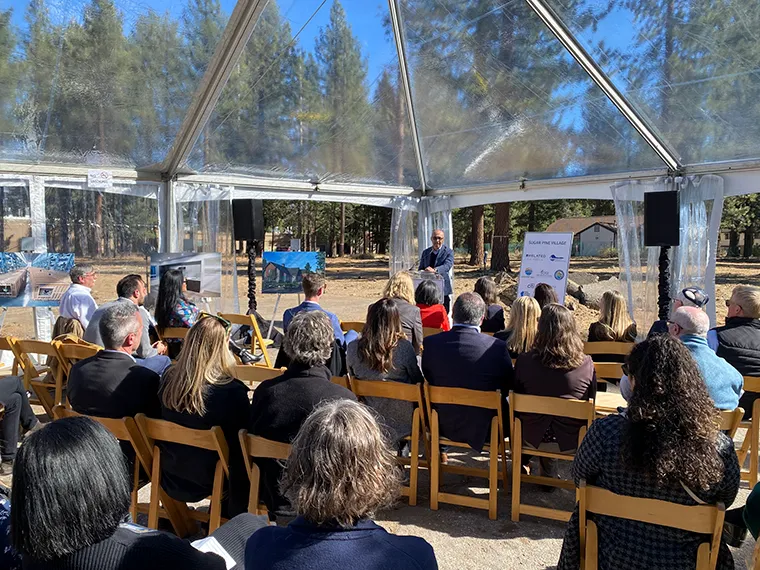
HCD Director Gustavo Velasquez at the site of Sugar Pine Village.

The California Department of General Services (DGS) and the California Department of Housing and Community Development (HCD) announced today the beginning of the first phase of Sugar Pine Village, a 248-unit community that will transform vacant state-owned land in South Lake Tahoe into affordable housing under Governor Gavin Newsom’s Excess Land for Affordable Housing Executive Order N-06-19.

Under the executive order, the California Tahoe Conservancy identified two parcels in South Lake Tahoe as ideal sites to build a sustainable, innovative housing project to meet the acute demand for workforce housing in the Tahoe Basin. The first phase kicked off site preparation and infrastructure to support 68 affordable housing units.

“Sugar Pine Village demonstrates the tremendous potential of unlocking state-owned lands and converting them to housing for the local workforce and for low- and very low-income Californians,” said Business, Consumer Services and Housing Agency Secretary Lourdes Castro Ramírez. “By creating a thriving mixed-use development near transit and pedestrian-friendly centers, Sugar Pine Village is helping to implement the state’s vision for using excess state sites to support vibrant, sustainable communities.”

“It is exciting to see property no longer in use by the state being converted to provide the housing that Californians need,” said Government Operations Agency Secretary Amy Tong. “We’re eager to replicate projects like Sugar Pine Village at locations across the state.”

“DGS was joined by a diverse group of local stakeholders to consider the tremendous need for affordable workforce housing at South Lake Tahoe and putting the people and pieces together to make this significant contribution to the scarce local rental housing supply,” said DGS Director Ana Lasso.

“We are proud to have made significant progress in transforming state-owned lands into affordable housing,” said HCD Director Gustavo Velasquez. “Communities like Sugar Pine Village in Lake Tahoe will support working families and individuals to live closer to where they work, go to school, and amenities—reducing transportation costs and climate impacts. The partnership and innovative thinking of this administration, DGS, developers and stakeholders across the state will move us closer to the nearly 1 million affordable homes needed by 2030.”

Developed by Related California, phase one includes 12 studios, 12 one-bedroom, 23 two-bedroom, and 21 three-bedroom units.

“Sugar Pine Village is an incredible example of what can happen when there is an innovative and collaborative partnership between multiple state and local stakeholders to combat California’s housing crisis. It was a true team effort to deliver the first phase of this project in record time. We look forward to continuing our partnership with Governor Newsom, DGS, HCD, City of South Lake Tahoe, and others to create this critical new affordable housing in the Tahoe Basin,” said Ann Silverberg, CEO of Related California’s Northern California Affordable and Pacific Northwest Divisions.

“The Sugar Pine Village project is one step toward addressing the housing crisis in the City of South Lake Tahoe. We are grateful for the joint efforts between the local and state entities, especially the Governor’s Office and the Department of Housing and Community Development, in bringing this project to fruition and we are excited to have remained on track with our projected timelines. We anticipate the installation of the first phase of units in Summer 2023. Affordable housing continues to be a top priority for us, and we will continue to look for opportunities to add more affordable housing to our city,” said Mayor Devin Middlebrook, City of South Lake Tahoe.

Developed by Related California and St. Joseph Community Land Trust, Sugar Pine Village is the first excess sites project to break ground under the Governor’s Executive Order and is the largest multifamily housing project ever to be entitled in South Lake Tahoe. The full 248-unit project received full environmental clearances and permitting in just 6 months by utilizing Senate Bill 35 ministerial approvals.

The Department of General Services acts as the business manager for the state of California. DGS helps state government better serve the public by providing services to state agencies including procurement and acquisition solutions, real estate management, leasing and design services, environmentally friendly transportation, and architectural oversight and funding for the construction of safe schools.

The California Department of Housing and Community Development is dedicated to the preservation and expansion of safe and affordable housing, so more Californians have a place to call home. Our team works to ensure an adequate supply of housing for Californians and promotes the growth of strong communities through its leadership, policy, and program development. For more information, please visit www.hcd.ca.gov and follow us on Twitter, @California_HCD; Facebook, @CaliforniaHCD; and LinkedIn.

Media Contacts:

DGS: Office of Public Affairs, DGSPublicAffairs@dgs.ca.gov

HCD: Alicia Murillo, Alicia.Murillo@hcd.ca.gov

  • Excess Sites
  • Press Release
  • October 24, 2022
    Excess California Tahoe Conservancy land will eventually provide 248 units of affordable workforce housing
    Off
    Article

    Success Stories: Lucia

    Off
    Lucia

    Lucia and her kids moved into an apartment made possible through funding from our Multifamily Housing and Serna programs and @Mercy Housing California.

    Lucia says she loves everything about her home and community and is especially grateful for what it has done for her kids.

    During COVID-19, Lucia lost her job and contracted the virus, but says her home was a safe haven and the staff at Mercy Housing were angels, providing food and supplies to her door and regularly checking in. “They were there for me in ways I didn’t know were possible. I just want to say, ‘thank you’ from the bottom of my heart.”

    View Lucia's video.

  • Success Stories
  • May 25, 2021
    Lucia is a single mom who had no choice but raise her three children in a single room after fleeing domestic violence.
    Off
    Article

    Success Stories: Nicolette

    Off
    Photo of Nicolette

    Nicolette says she moved a lot as a child and knows first-hand the impact moving around can have on kids. With concern in her eyes she says her son, at the age of six, has lived in seven different places. When a college classmate of Nicolette directed her toward Mercy Housing for help, she was surprised to learn that she and her children would be getting a permanent home and so much more.

    “They really are creating a community here. It’s not just an apartment complex. It’s not just somewhere we rent from. they really want to give people that feeling of belonging and community and acceptance, and, you know, it’s really a beautiful thing…especially when you haven’t always had that.”

    Nicole and her two children have lived in their home for four and a half years now and is happy to report her children are thriving.

    View Nicolette's video.

  • Success Stories
  • May 6, 2021
    HCD’s programs change lives. Meet Nicolette, whose home was made possible through funding from our Multifamily Housing Program and with Mercy Housing California.
    Off
    Article

    HCD and Attorney General Announce Lawsuit Against City of Anaheim

    Off
    Newsroom Default Image

    Sacramento — On behalf of the California Department of Housing and Community Development (HCD), the Attorney General moved to intervene today in a lawsuit against the City of Anaheim. The lawsuit alleges that Anaheim violated state housing laws by requiring and then denying a permit to Grandma’s House of Hope, a non-profit that wants to use an existing house for transitional housing for women with mental health disabilities who recently experienced homelessness.  

    The suit filed in the Orange County Superior Court alleges violations of the Housing Element Law, Housing Accountability Act, and statutes governing anti-discrimination in local land use laws. This includes, but is not limited to, statutes that require cities and counties to both refrain from discriminating against individuals or groups based on disabilities and to affirmatively further fair housing. The Attorney General is asking the court to allow HCD to intervene in a lawsuit that Grandma’s House of Hope filed against Anaheim earlier this year. 

    “The barriers that people with disabilities face daily are only compounded by discrimination. The state will take legal steps necessary to ensure that housing discrimination against people with disabilities and all Californians ends. Cities and counties across the state will be held accountable for attempts to evade fair housing and anti-discrimination laws,” said HCD Director Gustavo Velasquez. “The support and assistance that transitional housing providers like Grandma’s House of Hope deliver are essential in addressing California’s homelessness crisis and the shortage of housing for people with disabilities.”   

    “The City of Anaheim’s effort to limit Grandma’s House of Hope's ability to provide much-needed housing opportunities to this vulnerable group of women is a clear violation of California law,” said Attorney General Rob Bonta. “Cities and counties cannot discriminate against housing designed for people with disabilities or who have recently experienced homelessness. They also cannot require permits for transitional or supportive housing that they do not require for other housing in the same residential zone.” 

    According to the lawsuit, Anaheim requires transitional and supportive housing with more than six residents to apply for conditional use permits. Despite HCD notifying the city that the conditional use permit requirement is illegal, and Anaheim’s own Planning Department recommending that this transitional housing be allowed in the existing house as proposed, the city still required Grandma’s House of Hope to apply for a permit and then denied it. As alleged in the lawsuit, Anaheim rebuffed HCD’s efforts to obtain the city’s immediate and voluntary compliance with state law and has persisted in refusing to allow the 5,300 square-foot house, with eight bedrooms, on a 28,000 square-foot lot, to be used for transitional housing for more than six people. 

    The lawsuit seeks a court order that, among other things, stops Anaheim from imposing special conditions on transitional and supportive housing and from discriminating against housing based on its intended occupants’ disabilities or incomes. 

    A copy of HCD’s application to intervene, including its attached proposed complaint (Orange County Superior Court, case number 30-2022-01241823-CU-WM-CJC) is available here

  • Press Release
  • October 3, 2022
    Alleges That City Illegally Required and Denied Permit to Grandma’s House of Hope for Transitional Housing
    Monica Hernández
    (916) 890-5240
    Off
    Article
    Top