Health and Safety Code section 13869.7 establishes that fire protection districts may adopt building standards relating to fire and panic safety that are more stringent than those building standards adopted by the State Fire Marshal and contained in the California Building Standards Code.
Health and Safety Code (HSC) section 17959 establishes that a city, county, or city and county may, by ordinance, make changes or modifications in addition to or in excess of the requirements contained in the California Building Standards Code adopted pursuant to HSC sections 17922 and 18928.
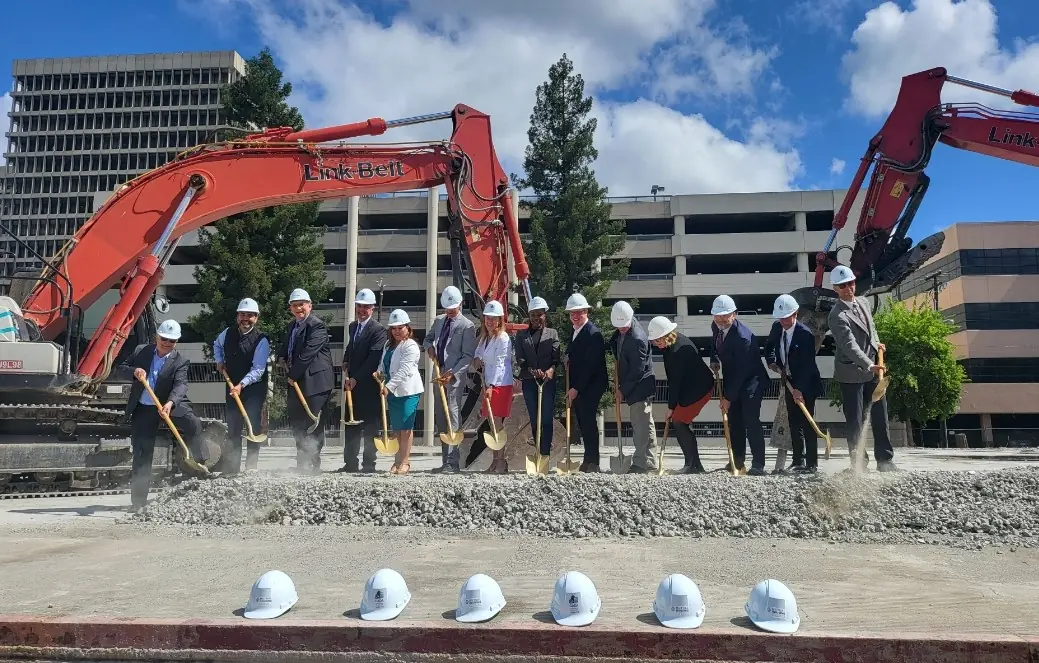
Governor Gavin Newsom today announced the groundbreaking of Monarch in Sacramento – the city’s third affordable housing community created on excess state land. The Monarch community will transform a former state-owned storage warehouse into 241 homes for low- to extremely low-income Sacramentans and is made possible by Governor Newsom’s executive order to identify and prioritize underutilized state property for clean, innovative, and cost-effective housing.
“Today’s groundbreaking in Sacramento illustrates the life-altering possibilities of converting excess and underutilized state lands into thriving local communities. With 32 housing developments currently awarded, California’s Excess Sites program provides the innovative boost needed to help alleviate the state’s affordable housing shortage,” said Governor Newsom.
First-in-the-nation program
Governor Newsom’s Excess Sites Program was the first housing initiative nationwide to release all state land identified as suitable and available for affordable housing development.
The Department of General Services (DGS) and the California Department of Housing and Community Development (HCD) partner to administer the Excess Sites Program, identifying state-owned land available and suitable for housing, and making a digital inventory of these properties available through a Developer Interest Submission Portal. In February 2025, Governor Newsom revamped and streamlined the Excess Sites Program by announcing a Developer Interest Submission Web portal, making it easier for developers to bid on state excess sites projects – improving the speed and efficiency with which state land is leased for affordable housing.
“Thanks to California’s Excess Sites Program, 20 previously under-utilized state properties will soon be transformed into 4,300 housing units, including the 241 homes at the Monarch,” said Business, Consumer Services and Housing Agency Secretary Tomiquia Moss. “Through continued investments in the Excess Sites program, the state is encouraging infill development, building affordable homes, and promoting healthier communities for future generations of Californians."
About the project
Monarch will bring much-needed affordable housing to a vibrant and growing mixed-use neighborhood in close proximity to transit, parks, restaurants, and shopping. 20 units will be reserved for people exiting or at risk of homelessness, with supportive services provided by Lutheran Social Services.
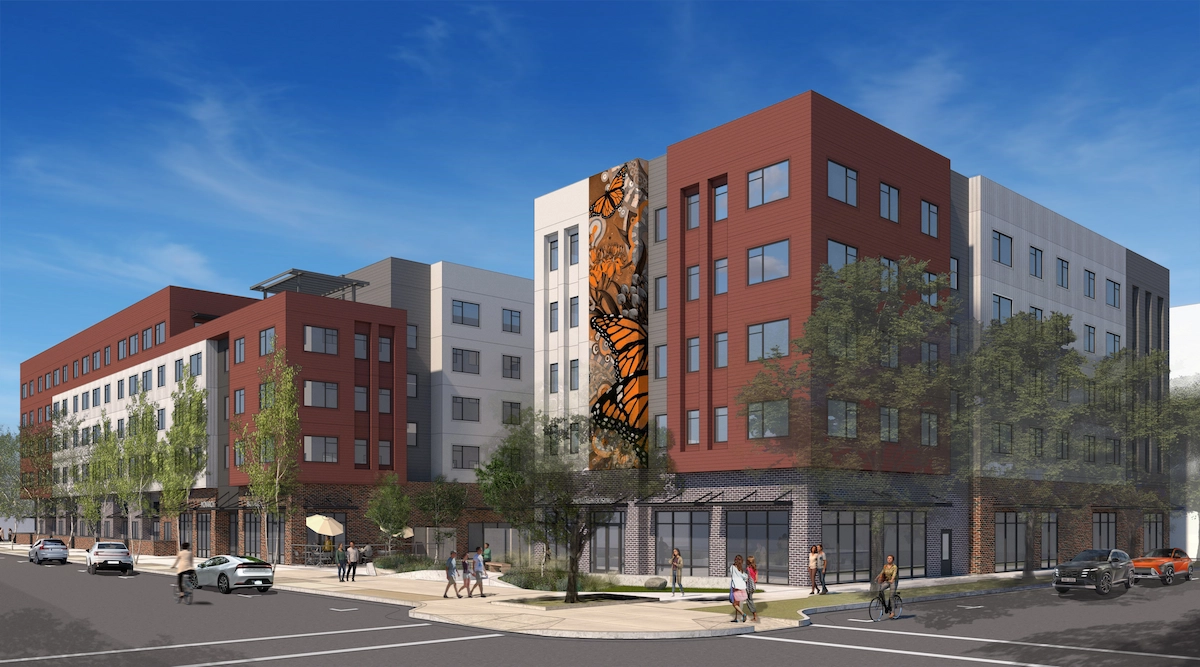
Rendering of Monarch housing development
“Monarch will ensure a safe haven for hundreds of Sacramentans whose access to secure housing is especially needed,” said Government Operations Agency Secretary Nick Maduros. “A stable home and proximity to amenities will allow Monarch’s residents to thrive and contribute to the renaissance taking place in this area of downtown.”
Monarch will include 3,428 square feet of retail space, 264 secured bicycle parking spaces, and 33 vehicle parking spots.
“Projects like Monarch are helping to breathe new life into city centers,” said HCD Director Gustavo Velasquez. “It is extremely gratifying to help make the Governor’s vision for state lands a reality, as properties that are not needed for a government purpose can advance the greater good of making affordable housing available in high-resource areas that connect Californians to opportunity and community.”
Monarch received $10 million in funding from HCD’s Local Government Matching Grant program to match the $3.3 million in funding from the City of Sacramento, waived impact fees from the City and County of Sacramento, and an $8 million gap loan from CADA, one of the site’s developers. Another $4 million was contributed by the California Housing Finance Agency through its Mixed-Income Program. The community is expected to welcome residents in the Spring of 2027.
“This is yet another significant partnership between DGS and CADA to create an affordable housing project here in Sacramento under the Governor’s Executive Order,” said DGS Director Ana M. Lasso. “It is so inspiring to see excess state-owned property repurposed to create living spaces that strengthen the local community here in the capital city.”
Since Governor Newsom launched the Excess Sites Program through his executive order, 32 housing development projects have been awarded totaling 4,300 homes in various phases of development. This pipeline includes 234 homes that are already constructed and occupied with another 424 homes currently under construction.
Transforming underutilized state land
In 2019, Governor Gavin Newsom issued an executive order calling on HCD and the Department of General Services to address the state’s affordable housing crisis by identifying underutilized state-owned sites for the development of affordable housing, taking into account factors such as proximity to job centers, amenities, and public transit. The order has since been utilized to create hundreds of affordable homes, including:
248 new homes at Sugar Pine Village for families and workers in the Tahoe region
What you need to know: Sacramento’s Monarch housing project is the latest affordable housing site brought to fruition under Governor Newsom’s executive order to develop excess and underutilized state lands into affordable new homes.
California law governing manufactured housing is entitled the "Manufactured Housing Act of 1980" and may be found in Division 13, Part 2, of the California Health and Safety Code, commencing with Section 18000.
Federal laws governing manufactured housing built on or after June 15, 1976, are found in Title 42, U.S. Code, Chapter 70, beginning Section 5401.
Mobilehome and special occupancy (RV) parks are required to have an active permit to operate and collect rent from residents. Permits may be renewed or amended online using Codes and Standards Online Services (C&S OS).
If there is no HCD record that a California Insignia of Approval was issued, your mobilehome, multifamily manufactured home, commercial modular, or special purpose commercial modular will need to be inspected before a new insignia can be issued.
HCD's inspection is conducted to determine compliance with codes and standards for electrical, heat producing, plumbing, fire and life safety systems and equipment. If violations are found, they must be corrected and then verified by reinspection.
For manufactured homes, each section of the manufactured home must have a HUD certification label (PDF) from HUD. Replacement labels are not offered for manufactured homes. The Institute for Building Technology and Safety (IBTS) can provide an owner with a label verification letter that will suffice for missing HUD labels.