
September 2025
California Announces Six More Prop. 1 Projects to House and Support Veterans and Others with Behavioral Health Challenges
Off
Sacramento, CA
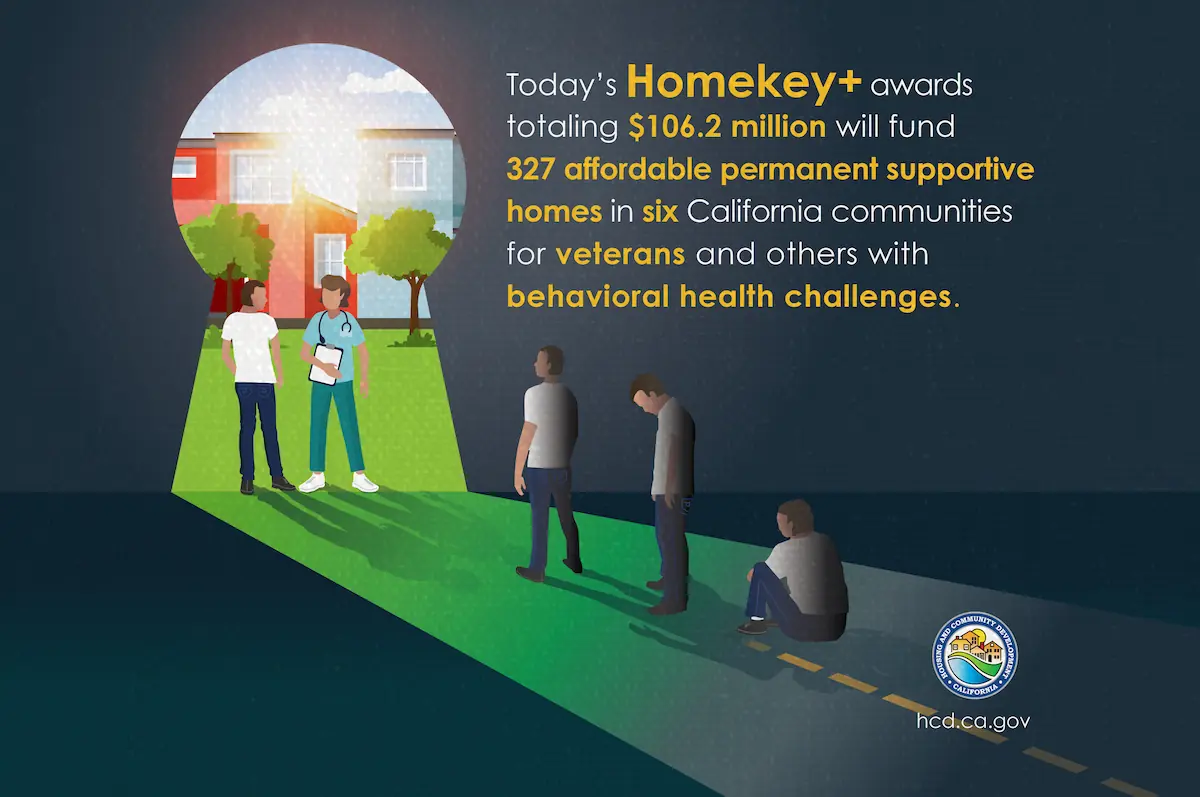
Governor Gavin Newsom today announced six Homekey+ awards to help fund the development of 321 permanent supportive homes with services for veterans and other Californians who are experiencing or at risk of homelessness and living with behavioral health challenges, along with six manager units. The funding is a result of Governor Newsom’s voter-approved Proposition 1 which is transforming California’s mental health system through a $6.4 billion Behavioral Health Bond for treatment settings and permanent supportive housing
“California has built a strong system to help local communities address the homelessness crisis," said Governor Gavin Newsom. "For decades prior to my administration, state leaders turned their backs on those dealing with mental health and addiction. I am committed to rebuilding a strong system of support and accountability to ensure that no one suffers on our streets without help. No more excuses — everyone must step up to address this crisis.”
In November 2024, the California Department of Housing and Community Development (HCD), in collaboration and partnership with the California Department of Veterans Affairs (CalVet), released a $2.145 billion Notice of Funding Availability (NOFA) for permanent supportive housing through the new Homekey+ program. Modeled after Governor Newsom’s highly successful Homekey program, Homekey+ was created with funding from voter-approved Proposition 1, which also provides funding to build residential care settings and expand access to behavioral health treatment.
With today’s awards, Homekey+ has so far awarded $284.6 million to support 16 projects that will create 825 affordable homes with supportive services throughout California. Of these homes, 164 are reserved for veterans experiencing or at risk of homelessness with behavioral health challenges.
“California’s Homekey+ program is investing in people and neighborhoods across the state, providing affordable housing and supportive services for Californians who are experiencing homelessness and living with behavioral health challenges," said Business, Consumer Services and Housing Agency Secretary Tomiquia Moss. "The supportive housing projects being awarded today are a testament to the Governor’s ongoing partnership with local jurisdictions and unwavering commitment to create housing for all Californians, including our Veterans and our most vulnerable.”
“This tremendous partnership with CalVet to house and support veterans and other Californians who are struggling is testament to the Governor’s fervent commitment to addressing a homelessness crisis decades in the making,” said HCD Director Gustavo Velasquez. “Across agencies and departments, we are working together—and with local partners—focusing our combined resources to build on ongoing successes in reducing unsheltered homelessness.”
“This new round of Homekey+ awards is more good news for California veterans and their families,” said CalVet Secretary Lindsey Sin. “We appreciate the hard work of the California Department of Housing & Community Development and other partners in creating innovative housing solutions across the state for those who have served our nation with honor and courage.”
Approximately $1.033 billion in Proposition 1 bond funds are available through Homekey+ to cities, counties, housing authorities, and tribal entities for projects serving veterans. Another $1.11 billion is available for projects serving all target populations, through a combination of Proposition 1 bond funds and Homeless Housing, Assistance, and Prevention (HHAP) program funds. The Homekey+ NOFA allocates funding by region based on a proportionate share of veterans and others experiencing homelessness, and by share of extremely low-income households whose rent is more than half of their income. There are also allocations for rural projects and for projects serving youth experiencing or at risk of homelessness. Homekey+ applications will continue to be reviewed and approved on a rolling basis.
The following awards announced today total $106.2 million to create 321, permanent supportive homes, with 76 units for veterans, in addition to six managers’ units:
- The City of Rancho Cordova, in partnership with Mercy Housing California, will receive $31.5 million in Homekey+ funding for the Mather Veterans Village Phase 4 Project. This new construction project will provide 69 much-needed permanent supportive homes for veterans experiencing homelessness with behavioral health challenges, in addition to one manager’s unit. Located on the former Mather Air Force Base, this development builds upon Veterans Housing and Homelessness Prevention (VHHP) program funding previously awarded by HCD as part of the broader Mather Veterans master plan. All residents will have access to comprehensive medical and behavioral health services at the Veterans Affairs Medical Center located just one block from the project site. On-site management and extra support from Nations Finest and Mercy Housing are in place to collaborate with County Behavioral Health to better meet resident needs.
- The City of Los Angeles, together with A Community of Friends, will receive nearly $20.5 million in Homekey+ funding for the Estrella Azul Project. The permanent housing project will consist of 80 homes, including one manager’s unit and two units not assisted by Homekey+ funds. The remaining 77 units are dedicated to individuals experiencing homelessness or chronic homelessness with behavioral health challenges. To support resident health and well-being, the project will include a 615-square-foot fitness room, as well as outdoor amenities such as a BBQ area and gardens. In addition to Homekey+ funding, the project has been awarded financing from the National Housing Trust Fund (NHTF), No Place Like Home (NPLH), Community Development Block Grant (CDBG), and Infill Infrastructure Grant (IIG) programs—totaling more than $30.9 million. The Los Angeles County Department of Mental Health and Department of Health Services will provide ongoing specialty mental health and supportive services. As the project moves forward, A Community of Friends will engage with local stakeholders to ensure the development honors the neighborhood’s broader history and cultural identity.
- The City of Chula Vista, in partnership with Wakeland Housing and Development Corporation, will receive $8.4 million to convert the Palomar Motel into a 28-unit permanent supportive housing site with 20 homes for individuals at risk of homelessness, seven homes designated for Veterans, and one onsite manager unit. The project will utilize a combination of project-based vouchers and HUD Veterans Affairs Supportive Housing (VASH) vouchers to help residents pay their rent. To further enrich and support the lives of the residents, the lead service provider—People Assisting the Homeless (PATH)—will provide case management services in conjunction with adult education, health and wellness services, skill-building classes, and life skills training. Additionally, the VA will provide specialized services and case management to veterans living there.
- The City of Oakland, Mark Twain Partners, and MPI Properties will receive nearly $33 million to rehabilitate and newly construct a continuation of the Mark Twain Homes project, a four-building development. The continuation of this project facilitates the conversion to a full permanent supportive housing project. This conversion adds another seven units to the project while making needed improvements to preserve the 102 existing homes, resulting in 109 units, including two manager units, to serve individuals experiencing homelessness, chronic homelessness, or at risk of homelessness. The rehabilitation and construction of the project includes the addition of a community room, space for supportive services, bicycle parking, landscaping, and a common space for all residents. The project is central to necessary amenities such as a full-scale grocery store, a medical clinic, a public park, and a public library.
- The City of Napa and Burbank Housing Development Corporation will receive just over $7.6 million to acquire and rehabilitate the 4th Street & Division Apartments, a two-site project consisting of 24 homes, including one manager’s unit, to serve people at risk of homelessness with behavioral health challenges. Located in a walkable, well-established neighborhood near downtown Napa, the project offers residents convenient access to grocery stores, public transit, and schools.
- The County of Glenn, in partnership with Habitat for Humanity Yuba/Sutter, Inc., will receive approximately $5.2 million to develop the Purpose Place Apartments Phase III, a new construction cost containment project. This two-story building will provide 18 homes to serve people experiencing homelessness with a behavioral health challenge. Additionally, the project will leverage California Advancing and Innovating Medi-Cal (CalAIM) operating subsidies to support high-quality, wraparound services for residents.
Across three rounds of the original Homekey program, HCD awarded $3.6 billion to fund 261 projects with 15,962 homes expected to house more than 175,000 Californians over the projects’ lifetimes.
From the very first moments of the Newsom administration, the national crisis of housing affordability and homelessness has been addressed with ingenuity, seriousness, and expertise. No other state has devoted as much time, attention, and resources to these twin problems. Governor Newsom is creating a structural and foundational model that will have positive impacts for generations to come:
✅ Addressing mental health and its impact on homelessness — Ending a long-standing 7,000 behavioral health bed shortfall in California by rapidly expanding community treatment centers and permanent supportive housing units. In 2024, voters approved Governor Newsom’s Proposition 1 which is transforming California’s mental health systems with a $6.4 billion Behavioral Health Bond for treatment settings and housing with services for veterans and people experiencing homelessness, and reforming the Behavioral Health Services Act to focus on people with the most serious illnesses, provide care to people with substance disorders, and support their housing needs. In May, Governor Newsom released $3.3 billion of this funding to create over 5,000 residential treatment beds and more than 21,800 outpatient treatment slots for behavioral health services.
✅ Creating new pathways for those who need the most help — Updating conservatorship laws for the first time in 50 years to include people who are unable to provide for their personal safety or necessary medical care, in addition to food, clothing, or shelter, due to either severe substance use disorder or serious mental health illness. Creating a new CARE court system that creates court-ordered plans for up to 24 months for people struggling with untreated mental illness, and often substance use challenges.
✅ Streamlining and prioritizing building of new housing — Governor Newsom made creating more housing a top state priority for the first time in history. He has signed into law groundbreaking reforms to break down systemic barriers that have stood in the way of building the housing Californians need, including broad CEQA reforms.
✅ Creating shelter and support — Providing funding and programs for local governments, coupled with strong accountability measures to ensure that each local government is doing its share to build housing, and create shelter and support, so that people rescued from encampments have a safe place to go.
✅ Removing dangerous encampments — Governor Newsom has set a strong expectation for all local governments to address encampments in their communities and help connect people with support. In 2024, Governor Newsom filed an amicus brief with the Supreme Court defending communities' authority to clear encampments. After the Supreme Court affirmed local authority, Governor Newsom issued an executive order directing state entities and urging local governments to clear encampments and connect people with support, using a state-tested model to address encampments humanely and provide people adequate notice and support.
September 17, 2025
Awards Totaling $106.2 Million Will Create 327 Homes to Address Homelessness Crisis
Pablo Espinoza
Off
Deputy Director of Communications
Article
CalHome Archive
Previous NOFAs
2024 CalHome Program
2021 CalHome Program
CalHome Resources
CalHome 2022 Program and Later
Beginning in 2022, the CalHome Program is now part of the Homeownership Super NOFA. CalHome program guidelines and NOFAs can be found on the Homeownership Super NOFA website.
CalHOME Program
The CalHome Program provides grants to local public agencies and nonprofit corporations for first-time homebuyer and housing rehabilitation assistance, homebuyer counseling and technical assistance activities to enable low- and very low-income households to become or remain homeowners.
This program is included in the Homeownership Super NOFA.
California claims victory – again – over Huntington Beach as appeals court rules against city's NIMBY violations of state law
Off
Sacramento, CA
Governor Gavin Newsom and Attorney General Rob Bonta have secured another ruling against the city of Huntington Beach for violations of state housing law. The California court of appeal ruled that the city faces a 120-day deadline to update its plan and restrictions on its control over permitting and development until it complies with the law.
“Huntington Beach officials have wasted vast sums of taxpayer dollars to defend clearly unlawful NIMBY policies. They are failing their own citizens — by wasting time and money that could be used to create much-needed housing. No more excuses — every city must follow state law and do its part to build more housing,” said Governor Gavin Newsom
“The deadline for Huntington Beach to submit a compliant housing element was October 15, 2021, nearly four years ago. At a time when California is experiencing a housing crisis of epic proportions, the City’s continued reluctance to follow the law is inexcusable, and we have been in court seeking accountability. Today’s win is an important development. Huntington Beach is running out of excuses, and the consequences for failing to plan for its fair share of housing are becoming clearer and more serious. The City has already lost its federal lawsuit challenging the constitutionality of certain California housing laws, and now it has lost its claim that it is exempt from California's housing laws,” said Attorney General Rob Bonta.
In March 2023, the state sued Huntington Beach for violating state law requiring it to update its housing plan. Last year, the trial court agreed with the state that the city had violated the law, but failed to impose a 120-day deadline for the city to update its plan, and failed to impose consequences limiting the city’s control over permitting and development until it complies with the law. The court of appeal today rejected the city’s argument that it is exempt from these consequences, and ordered the trial court to enter a new order to hold the city accountable until it comes into compliance with the law.
"This is an important victory in our challenge to Huntington Beach's refusal to do its fair share in addressing the statewide housing crisis," said Gustavo Velasquez, Director of the California Department of Housing and Community Development. "Every city, including charter cities, has a legal and moral responsibility to promote housing opportunities for people at all income levels, and HCD will continue to hold Huntington Beach and other recalcitrant jurisdictions accountable."
More housing. More accountability.
Governor Newsom championed the creation of the Housing Accountability Unit at HCD to ensure cities and counties fulfill their legal responsibilities to plan and permit their fair share of housing. Since its establishment, the Housing Accountability Unit has supported the development of 10,089 housing units, including more than 3,328 affordable units, through enforcement actions and by working with local jurisdictions to ensure compliance with housing law. In 2024, the Unit was expanded to include a focus on homelessness issues, including compliance with state laws related to homeless housing.
Today’s announcement follows the Governor’s recent announcement of the unit’s settlement with the city of Norwalk, requiring the city to overturn its illegal ban on homeless shelters. In addition to today’s announcement and work to hold local governments accountable to help their residents and improve affordability, Governor Newsom is creating a structural and foundational model that will have positive impacts for generations to come.
The Governor is streamlining and prioritizing building of new housing, funding new shelters, housing, and supports, holding local governments accountable, addressing mental health and its impact on homelessness through voter-approved Proposition 1, removing dangerous encampments, and creating new pathways for those who need it most through updated conservatorship laws and a new CARE court. This work is all creating positive results.
Reversing a decades-in-the-making crisis
Between 2014 and 2019 — before Governor Newsom took office — unsheltered homelessness in California rose by approximately 37,000 people. Since then, under this Administration, California has significantly slowed that growth, even as many other states have seen worsening trends. In 2024, while homelessness increased nationally by over 18%, California limited its overall increase to just 3% — a lower rate than in 40 other states. The state also held the growth of unsheltered homelessness to just 0.45%, compared to a national increase of nearly 7%. States like Florida, Texas, New York, and Illinois saw larger increases both in percentage and absolute numbers. California also achieved the nation’s largest reduction in veteran homelessness and made meaningful progress in reducing youth homelessness.
September 12, 2025
Governor Newsom reaches agreement with Artesia on violations of state housing law, city ordered to create plan for thousands of new homes
Pablo Espinoza
Off
Deputy Director of Communications
What you need to know: A California court of appeal ruled that the city of Huntington Beach must comply with state law requiring it to plan for its fair share of housing. California will continue to hold the city accountable and ensure that it accommodates the housing its community deserves.
Article
Governor Newsom reaches agreement with Artesia on violations of state housing law, city ordered to create plan for thousands of new homes
Off
Sacramento, CA
Governor Gavin Newsom and Attorney General Rob Bonta today announced that Artesia has agreed to a settlement to resolve violations of state housing law, putting the city on an expedited timeline to submit a compliant housing element to the Department of Housing and Community Development. If approved by the court, the new plan will create 1,069 new homes, including 608 that will be affordable for very low-, low-, and moderate-income Californians.
“Artesia has wasted time and money stalling on their obligations when they could have instead been providing necessary housing for the families in their community. Every jurisdiction must do their part to create more housing and make their communities more affordable," said Governor Gavin Newsom.
All cities are required to adopt a compliant housing element. The housing element is a crucial tool for building housing for moderate-, low-, and very low-income Californians.
The settlement, which was entered into after the city failed to submit a compliant housing element, lays out deadlines for the City to revise the housing element of its general plan for the period from 2021 to 2029, holds the city accountable for its failure to do so before the statutory deadline, and clarifies the consequences of continued non-compliance with the Housing Element Law.
“I commend the City of Artesia for doing the right thing. Instead of continuing to kick the can down the road, the City has finally committed to do its part to plan for the region’s housing needs,” said Attorney General Rob Bonta. “Cities and counties that still have not adopted compliant housing elements should pay close attention. The deadline for compliance passed years ago, and so, this settlement includes new enforcement tools. Planning for housing is not an abstract exercise. Californians need quality homes that they can afford. Governor Newsom, HCD Director Velasquez, and I will continue fighting to ensure that every local government — no matter how small or big — follows state law and helps address our state’s housing crisis.”
Among other things, a compliant housing element must include an assessment of housing needs, an inventory of resources and constraints relevant to meeting those needs, and a program to implement the policies, goals, and objectives of the housing element. Once the housing element is adopted, it is implemented through zoning ordinances and other actions that put its objectives into effect and facilitate the construction of new homes for Californians at all income levels.
After repeated attempts to assist the city come into compliance, HCD’s Housing Accountability Unit — launched by Governor Newsom in 2021 — issued a Notice of Violation in May 2023. The City responded with a proposed timeline for compliance, but then failed to meet its own deadline. HCD issued a Notice of Violation (NOV) in October 2024. Today’s agreement holds Artesia to a binding timeline for compliance, with clear legal and financial consequences for any further delays.
"This outcome further reinforces California's housing laws that ensure every locality is doing its part to build homes and address this crisis," said HCD Director Gustavo Velasquez. "HCD stands ready to help Artesia and all local jurisdictions comply with state housing law, and we will continue to demand accountability from jurisdictions falling short of that critical responsibility."
A copy of the petition and proposed judgment, which details the settlement terms and remains subject to court approval, can be found here and here.
More housing. More accountability.
Governor Newsom championed the creation of the Housing Accountability Unit at HCD to ensure cities and counties fulfill their legal responsibilities to plan and permit their fair share of housing. Since its establishment, the Housing Accountability Unit has supported the development of 10,089 housing units, including more than 3,328 affordable units, through enforcement actions and by working with local jurisdictions to ensure compliance with housing law. In 2024, the Unit was expanded to include a focus on homelessness issues, including compliance with state laws related to homeless housing.
Today’s announcement follows the Governor’s recent announcement of the unit’s settlement with the city of Norwalk, requiring the city to overturn its illegal ban on homeless shelters. In addition to today’s announcement and work to hold local governments accountable to help their residents and improve affordability, Governor Newsom is creating a structural and foundational model that will have positive impacts for generations to come.
The Governor is streamlining and prioritizing building of new housing, funding new shelters, housing, and supports, holding local governments accountable, addressing mental health and its impact on homelessness through voter-approved Proposition 1, and creating new pathways for those who need it most through updated conservatorship laws and a new CARE court system. This work is all creating positive results. The Governor also recently announced a new statewide task force to help address encampments on state right of ways in the state’s ten largest cities, bringing together this comprehensive framework to get people into housing and off the streets.
Together with local partners, the Task Force will focus on encampment operations throughout the state within the next 30 days. The task force will work in a unified way across state government to clear highly visible and unsafe encampments on state property while expanding access to housing, shelter, mental health, and substance use services. Locations identified include areas with large encampments and high-priority encampments on state rights-of-way in California’s ten most populous cities: Los Angeles, San Francisco, Oakland, San Diego, Sacramento, San Jose, Long Beach, Anaheim, Bakersfield, and Fresno.
Reversing a decades-in-the-making crisis
Between 2014 and 2019 — before Governor Newsom took office — unsheltered homelessness in California rose by approximately 37,000 people. Since then, under this Administration, California has significantly slowed that growth, even as many other states have seen worsening trends.
In 2024, while homelessness increased nationally by over 18%, California limited its overall increase to just 3% — a lower rate than in 40 other states. The state also held the growth of unsheltered homelessness to just 0.45%, compared to a national increase of nearly 7%. States like Florida, Texas, New York, and Illinois saw larger increases both in percentage and absolute numbers. California also achieved the nation’s largest reduction in veteran homelessness and made meaningful progress in reducing youth homelessness.
September 9, 2025
Governor Newsom reaches agreement with Artesia on violations of state housing law, city ordered to create plan for thousands of new homes
Pablo Espinoza
Off
Deputy Director of Communications
What you need to know: Governor Newsom and Attorney General Rob Bonta have reached a settlement with Artesia to bring the city into compliance with state housing law.
Article
ICYMI—Hundreds of New, Safe, Affordable Rental Homes Brought Housing Stability to Californians Up and Down the State in August
Off
Sacramento, CA

The California Department of Housing and Community Development (HCD) joined community leaders and residents up and down the state in celebrating hundreds of safe, affordable new homes opening their doors to Californians in need of housing stability. Meanwhile, ground was broken on another innovative development, and several rounds of funding were announced to add 1,252 affordable homes to the state’s development pipeline—adding momentum to California’s focused efforts to address housing affordability and homelessness…
- HCD Director Gustavo Velasquez joined Los Angeles community leaders for the grand opening of Homekey Harbor City, a 50-home community with critical supportive services for low-income veterans, seniors, and families made possible with $7.9 million in funding from Governor Gavin Newsom’s highly Homekey program—now the model for the new Homekey+ program made possible in large part by voter-approved Proposition 1.
- HCD also celebrated the grand opening of the 43-home Eaglepointe Apartments in Paradise, supported by $7.4 million from the Department’s federal Community Development Block Grant—Disaster Recovery (CDBG-DR) program, which continues to help the community rebuild from the devastating Camp Fire.
- In Watsonville, Sparrow Terrace opened 72 new affordable homes, thanks to $11 million from HCD’s Farmworker Housing Grant Program and No Place Like Home.
- Sacramento celebrated the grand opening of two new communities in August: Powell’s Landing transformed a former hotel into 69 studio units with $20.3 million in Homekey funding, while the Oak Park community celebrated 43 new homes for seniors at Glendon, made possible by a $1.9 million Infill Infrastructure Grant Program investment.
- Santa Cruz broke ground on the Downtown Library Mixed-Use Project. Funded by $33.5 million from the Affordable Housing and Sustainable Communities Program jointly administered with the California Strategic Growth Council, the project will bring 124 affordable homes offering childcare, a library, and hosting a weekly farmer’s market.
- HCD announced $144.5 million in awards from the federal HOME Investment Partnerships Program (HOME) to increase the supply of affordable single- and multi-family housing in California and support local housing assistance programs. These awards will fund the construction of 643 new homes and help 984 households in rural and small communities.
- HCD’s federal team also announced two awards totaling $52.6 million in Disaster Recovery Housing Accelerator funds to create 91 affordable rental homes in San Luis Obispo and Ventura counties, which were affected by the winter storms of 2022-23.
- In August, HCD also announced three more Homekey+ awards totaling $75.5 million, building on the promise made through Proposition 1 to create safe, affordable housing coupled with critical supportive services for veterans and other Californians facing behavioral health challenges. The most recent announcement brings the total awarded so far through Homekey+ to $178.4 million, funding 518 permanent supportive homes, including 88 homes for our nation’s deserving veterans.
From the very first moments of the Newsom administration, the national crisis of housing affordability and homelessness has been addressed with ingenuity, seriousness, and expertise. No other state has devoted as much time, attention, and resources to these twin problems. Governor Newsom is creating a structural and foundational model that will have positive impacts for generations to come:
✅ Addressing mental health and its impact on homelessness — Ending a long-standing 7,000 behavioral health bed shortfall in California by rapidly expanding community treatment centers and permanent supportive housing units. In 2024, voters approved Governor Newsom’s Proposition 1 which is transforming California’s mental health systems with a $6.4 billion Behavioral Health Bond for treatment settings and housing with services for veterans and people experiencing homelessness, and reforming the Behavioral Health Services Act to focus on people with the most serious illnesses, provide care to people with substance disorders, and support their housing needs. In May, Governor Newsom released $3.3 billion of this funding to create over 5,000 residential treatment beds and more than 21,800 outpatient treatment slots for behavioral health services.
✅ Creating new pathways for those who need the most help — Updating conservatorship laws for the first time in 50 years to include people who are unable to provide for their personal safety or necessary medical care, in addition to food, clothing, or shelter, due to either severe substance use disorder or serious mental health illness. Creating a new CARE court system that creates court-ordered plans for up to 24 months for people struggling with untreated mental illness, and often substance use challenges.
✅ Streamlining and prioritizing building of new housing — Governor Newsom made creating more housing a top state priority for the first time in history. He has signed into law groundbreaking reforms to break down systemic barriers that have stood in the way of building the housing Californians need, including broad CEQA reforms.
✅ Creating shelter and support — Providing funding and programs for local governments, coupled with strong accountability measures to ensure that each local government is doing its share to build housing, and create shelter and support, so that people rescued from encampments have a safe place to go.
✅ Removing dangerous encampments — Governor Newsom has set a strong expectation for all local governments to address encampments in their communities and help connect people with support. In 2024, Governor Newsom filed an amicus brief with the Supreme Court defending communities' authority to clear encampments. After the Supreme Court affirmed local authority, Governor Newsom issued an executive order directing state entities and urging local governments to clear encampments and connect people with support, using a state-tested model to address encampments humanely and provide people adequate notice and support.
September 15, 2025
Pablo Espinoza
Off
Deputy Director of Communications
Article
Tribal Homeless Housing, Assistance and Prevention (Tribal HHAP) Grants Program
Tribal HHAP provides flexible funding to California Federally Recognized Tribes for a variety of unique, culturally responsive interventions to prevent and address homelessness in their communities.
For information on other grants available for tribal governments in California, visit the California Grants Portal and check “tribal governments” under the Applicant Type.
Top