June 2026

Governor Newsom swears in Tomiquia Moss as Secretary of new California Housing and Homelessness Agency

Off
Sacramento, CA
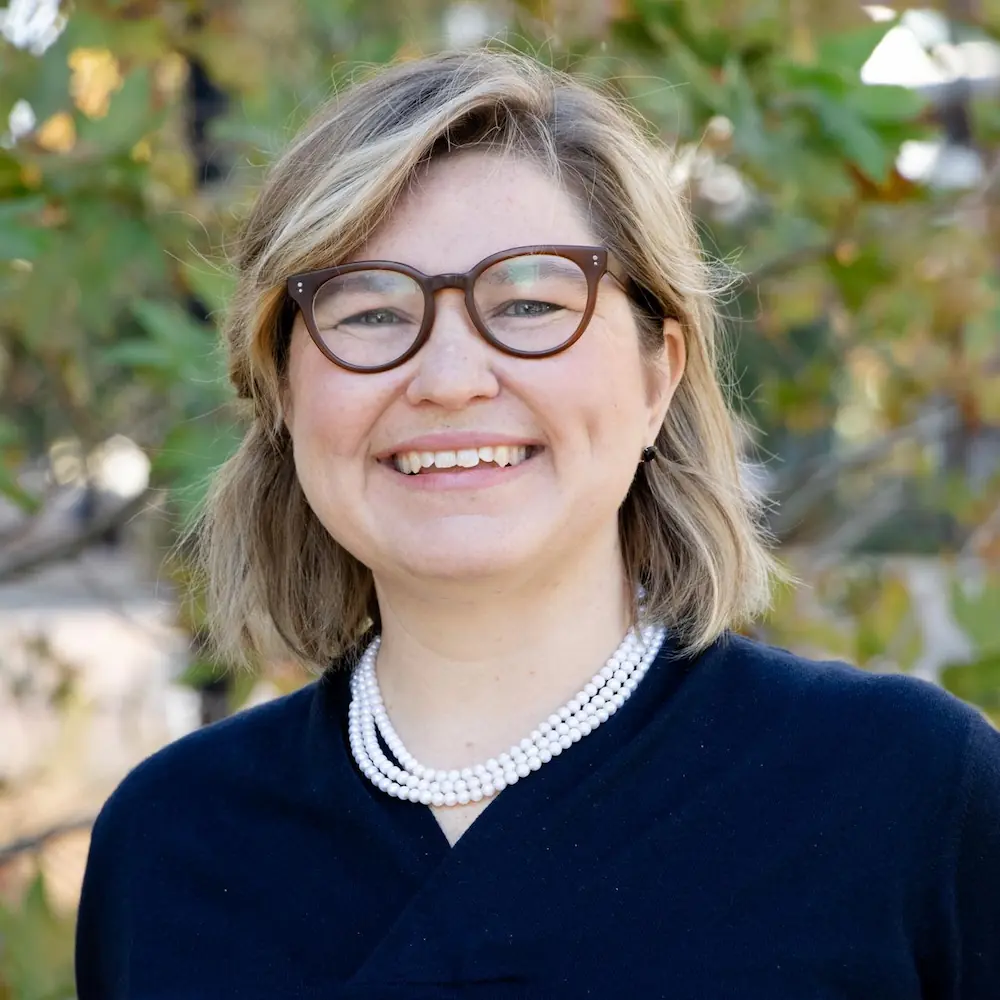
Governor Newsom swearing in Secretary Moss

Building on the administration’s efforts, which are reversing decades of inaction on housing and homelessness, Governor Gavin Newsom today announced the appointment of Tomiquia Moss, who will lead the California Housing and Homelessness Agency — which was established by Governor Newsom last year. The announcement comes after the Governor signed into law housing finance reforms as part of the 2026-2027 State Budget and a historic Veterans and Affordable Housing Bond Act of 2026 to help fund housing construction, preserve affordable housing, expand homeownership opportunities through assistance for veterans and middle- and lower-income households, and increase the supply of affordable rental housing as well as interim and supportive housing for people experiencing homelessness.

"I’m proud to appoint Tomiquia Moss to lead the California Housing and Homelessness Agency. Tomiquia is a proven leader who understands that housing is foundational to opportunity, dignity, and economic security. We created this agency because California needed a single, coordinated strategy to confront homelessness, expand housing, and protect the rights of every Californian. Thanks to historic investments and an all-hands-on-deck approach, we’ve made real progress — but we’re not letting up. Tomiquia has the experience, the grit, and the vision to build on that momentum and drive the next phase of this work," said Governor Newsom.

“I’m honored to lead the California Housing and Homelessness Agency and to advance the Governor’s vision for a more coordinated and accountable housing system," said California Housing and Homelessness Agency Secretary Tomiquia Moss. "As we expand opportunity, I’m committed to protecting the civil rights of every Californian while accelerating housing production and strengthening our homelessness response. I look forward to working with the Governor, the Legislature, and local partners to deliver stability, fairness, and dignity across our communities.” 

Since 2019, the Newsom administration has created unprecedented policy and structural changes in state government to help California better address its housing and homelessness crises, including additional and historic support for local governments, stronger accountability and enforcement, transformational changes to mental health services, and groundbreaking reforms — including groundbreaking legislative reforms signed last year, including updates to CEQA. These changes have helped connect hundreds of thousands of people at risk of or experiencing homelessness with vital supports. 

In her previous role as Secretary of the Business, Consumer Services and Housing Agency, Secretary Moss oversaw 12 entities and over 40 boards and bureaus and played an integral role in creating and advancing the administration’s strategies, leading to historic accomplishments. 

The Secretary has led major improvements to California’s housing delivery and finance systems, driving the construction of hundreds of thousands of homes, expanding affordable housing opportunities, and scaling innovative programs like Homekey that have created new housing units and connected large numbers of Californians to stability.

Reversing decades of inaction 

This work has created immediate, measurable results and the critical foundation necessary to finally solve California’s housing and homelessness crisis. Governor Newsom’s policies have had a significant impact: 

  • Historic drops in homelessness — The largest statewide reduction in unsheltered homelessness in 16 years with a 9% reduction in unsheltered homelessness across 30 continuums of care that reported updates in 2025. New federal data also shows California last year saw:
    • Largest reduction in unsheltered homelessness in the nation. California reduced unsheltered homelessness by 8,391 people, or 6.8% — more than any other state. That decline is more than twice the national reduction of 2.9% and significantly exceeds the next largest state, Texas, with a 1.4% decrease. 
    • Total homelessness declined. California’s overall homeless population dropped by 2.8%, marking the largest statewide decline since 2009. 
    • Leading the nation in reducing homelessness in key populations. From 2023 to 2025, California ranked first among all states and the District of Columbia in reducing veteran homelessness, chronic homelessness, homelessness among young adults ages 18-24, and homelessness among parents under 25. 

In addition, Governor Newsom is addressing a housing shortage decades in the making. Since 2019: 

  • Building is happening faster — Annual residential construction has increased by 59%, from 70,000 homes built in 2018 to about 111,000 in 2024. 
  • Multifamily construction has reached its highest level in decades — Over the last five years, more multifamily housing units have been built than in any five-year period in over 30 years, and more than 682,000 homes overall have been built statewide since 2019. 
  • Approval times have been slashed — Streamlining laws enacted since 2019 have cut average time from development application to entitlement by 57%, from 160 days to 68 days in 2024. The time from entitlement to permit also dropped by 9%. 
  • Communities are ready to build more — Through Governor Newsom’s work to ensure all jurisdictions do their part, communities throughout the state have laid the groundwork and have planned to accommodate at least 3.6 million new homes, including 1.4 million affordable units, moving California closer to meeting its long-term housing needs.

A structural shift for long-term solutions 

The 2026-27 State Budget funds the California Housing and Homelessness Agency, ensuring that California remains focused on long-term, scalable solutions that serve current and future generations. The California Housing and Homelessness Agency (CHHA) will concentrate on coordinating efforts across government to tackle housing and homelessness challenges, as well as protecting Californians' civil rights. In this all-of-government approach, CHHA will utilize resources and expertise within government to address these important issues. It includes the following departments: 

  • The Housing Development and Finance Committee (HDFC) 
  • Department of Housing and Community Development (HCD) 
  • California Interagency Council on Homelessness (Cal ICH) 
  • California Housing Finance Agency (CalHFA) • Civil Rights Department (CRD)  
  • Press Release
  • June 30, 2026
    Off

    What you need to know: As part of California’s strategy to combat homelessness and expand housing, Governor Gavin Newsom is announcing the appointment of Tomiquia Moss as the incoming secretary of the new California Housing and Homelessness Agency. The Governor has also signed a historic housing package and budget funding the agency and groundbreaking reforms to help increase homeownership and affordable housing statewide.
    Article

    SB 79 Transit-Oriented Development Housing Element Sites

    Senate Bill (SB) requires that qualifying housing developments located within a transit‑oriented development (TOD) zone be permitted as an allowed use on any parcel zoned for residential, mixed‑use, or commercial development, provided the project complies with applicable statutory requirements. Among these requirements, projects must include at least five dwelling units and meet the statute’s height, density, and residential floor area ratio (FAR) standards, which vary based on proximity to specified tiers of TOD stops.

    Governor Newsom awards $38.2 million to help tribes expand housing and homelessness solutions

    Off
    Sacramento, CA
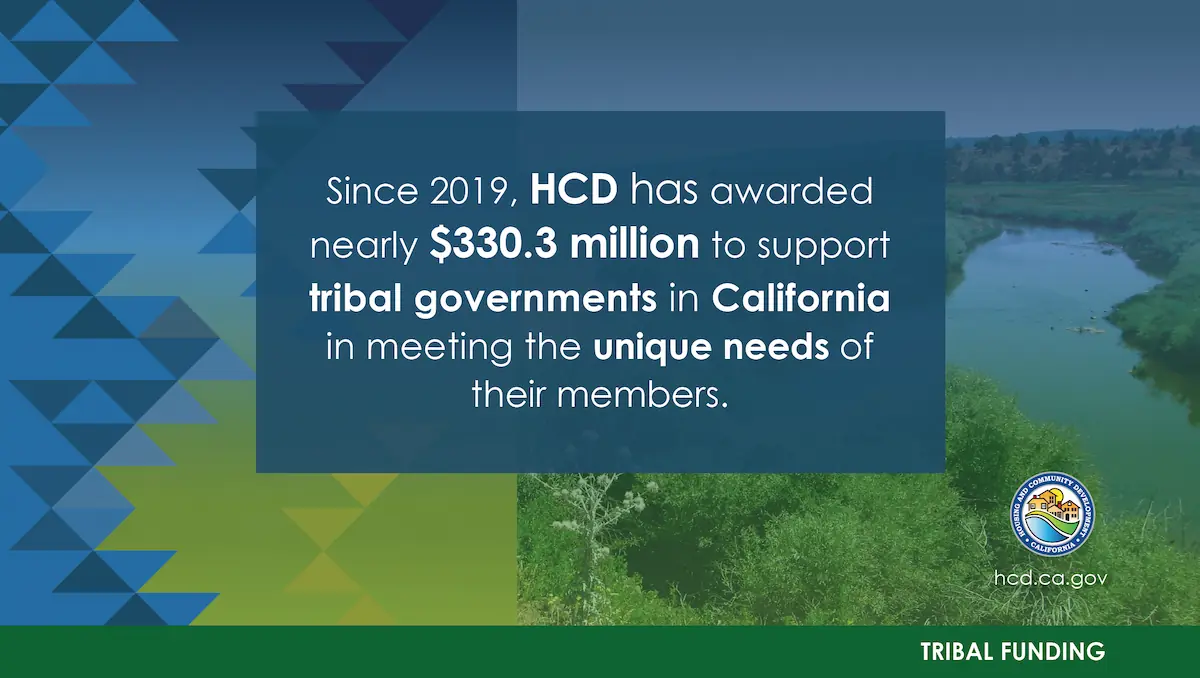
    image of nature with text that says "since 2019, HCD has awarded nearly $330.3 million to support tribal governments in california in meeting the unique needs of their members."

    Governor Gavin Newsom today announced awards totaling nearly $38.2 million to support California Native American communities in funding housing and homelessness solutions that meet their communities’ unique needs.

    “California is strengthening its partnership with tribal governments through programs and initiatives rooted in dignity, self-determination, and stability,” said Governor Gavin Newsom. “Tribal communities know their people, their histories, and their challenges best. This government-to-government approach is designed to respect tribal sovereignty while addressing historic inequities and supporting efforts to reduce homelessness and help more Californians move off the streets and into safe, stable housing.”

    Sixty-eight federally recognized tribes were awarded a total of $28.5 million through Round 4 of the California Department of Housing and Community Development (HCD) Tribal Homeless Housing, Assistance and Prevention Program (Tribal HHAP). The program provides flexible funding to implement unique, culturally responsive interventions to help tribal governments prevent and end homelessness within their communities.  

    "As Chairwoman, I am proud that we have secured this grant to help address homelessness and housing instability in our community," said Chairwoman Angela Elliott-Santos, Manzanita Band of the Kumeyaay Nation. "Through this funding, the Tribe will be able to provide safe, culturally supportive interim shelter for individuals experiencing homelessness. We are grateful to the California Department of Housing and Community Development for investing in Tribal-led solutions that advance Tribal sovereignty and empower Tribes to meet the unique needs of their communities.

    Tribal governments have faced historical disinvestment and barriers in accessing both state funding and traditional financing for affordable housing. Created with tribal sovereignty and self-determination in mind, Tribal HHAP and other investments into tribal communities aim to remove barriers and increase access to housing resources. Since 2019, California, through HCD programs, has made 174 awards totaling nearly $330.3 million to tribal governments.

    “Tribal HHAP and Tribal Homekey+ strengthen tribal communities by removing long‑standing barriers and honoring their sovereign, community‑driven approaches to housing,” said Business, Consumer Services and Housing Agency Secretary Tomiquia Moss. “These innovative programs reflect this administration’s deep commitment to solutions rooted in sovereignty, respect, and partnership so that tribal governments are supported in building a future where every community member is safely housed.” 

    Since its inception, Tribal HHAP has served more than 3,325 people in tribal communities. Nearly $15 million invested in permanent housing solutions has resulted in the creation or renovation of 319 permanent housing units, providing homes to more than 636 people in tribal communities. An additional $34 million-plus has been invested in youth homelessness interventions, serving over 758 youth experiencing homelessness. Under Governor Newsom’s leadership, HCD has increased the number of tribal governments receiving Tribal HHAP funds by 83% since the previous round, and 330% since the first round of Tribal HHAP funding. 

    “HCD is proud to work hand-in-hand with our tribal partners to advance programs that break down historic barriers to affordable housing finance,” said HCD Director Gustavo Velasquez. “Through programs built around tribal sovereignty, we have the flexibility to fund housing and homelessness solutions through which tribes can best address the unique needs of their members.” 

    Visit HCD's website to see a full list of Tribal HHAP awards.  

    In addition to the Tribal HHAP awards, the Kashia Band of Pomo Indians of the Stewarts Point Rancheria was awarded nearly $9.7 million for the Kashia Windsor Housing Project, under the new Tribal Homekey+ Program funded by voter-approved Proposition 1. The funds will provide 22 affordable rental homes for people at risk of homelessness. The majority of tribal members reside in Sonoma, Mendocino, Lake, and Napa Counties.

    An approach that works 

    In addition to today’s announcement, Governor Newsom is creating a structural and foundational model across the state that will have positive impacts for generations to come. 

    The Governor is streamlining and prioritizing building new housing, funding new shelters, housing, and supports, addressing mental health and its impact on homelessness through voter-approved Proposition 1, and creating new pathways for those who need it most through updated conservatorship laws [us.list-manage.com] and a new CARE court system. California is also addressing encampments statewide to help get people off the streets and into care. All this work is creating positive results. 

    Last year, as a result of the Governor’s strategies to address the housing and homelessness crisis, for the first time in over 15 years, California’s unsheltered homelessness decreased by 9.5%. While other states and the nation as a whole continue to see homelessness rising, California is reversing a crisis decades in the making.  

  • Homelessness
  • Press Release
  • June 24, 2026
    HCD Communications
    Off

    What you need to know: Building on progress in reducing homelessness in California tribal communities, Governor Gavin Newsom announced $38.2 million in funding for housing and homelessness solutions that support culturally responsive interventions for tribal communities. This funding supports permanent housing solutions, youth interventions, and flexible solutions for the unique needs of tribal communities.

    Article

    HCD Recognized for Commitment to Inclusive Business Practices

    Off
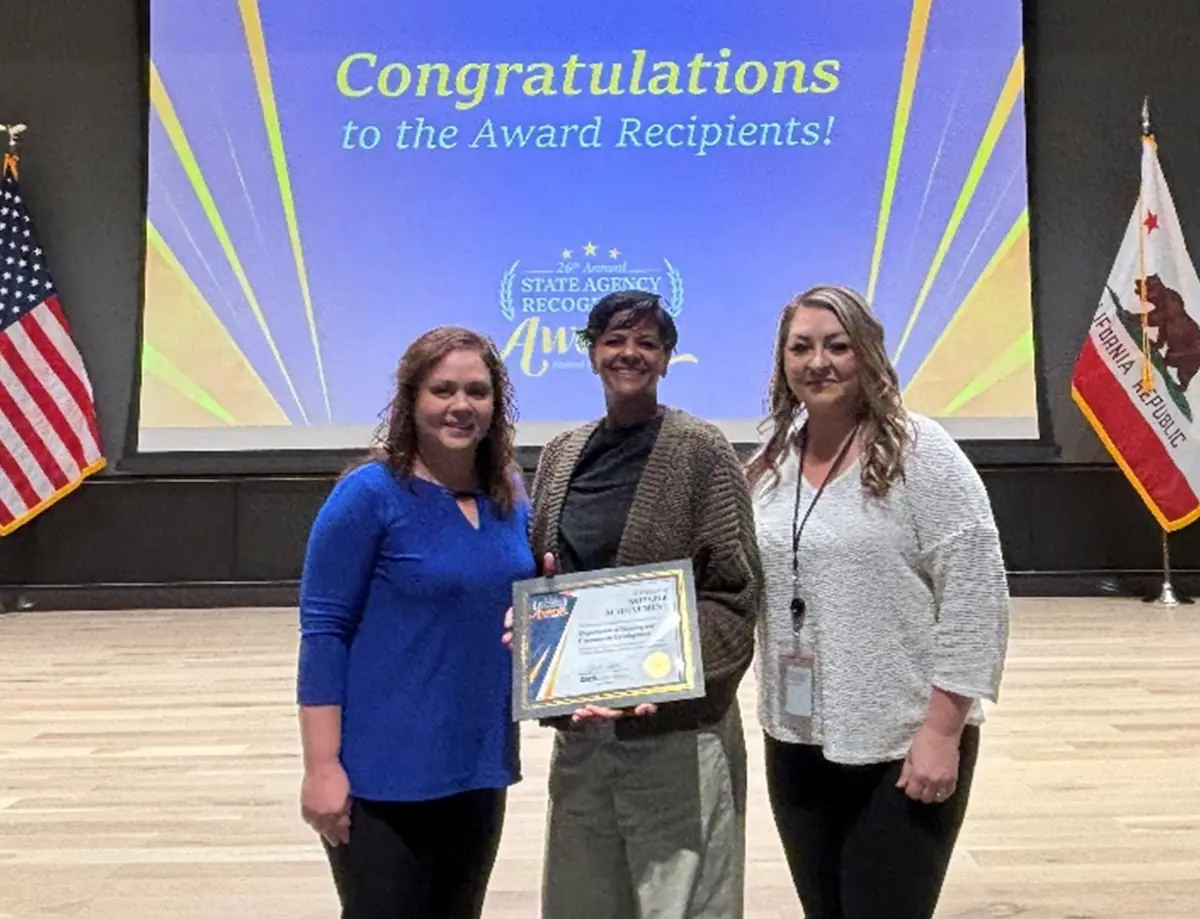
    three HCD staff members posing with award

    HCD was recognized at the recent 26th Annual State Agency Recognition Awards (SARA) for going above and beyond state goals for Small Business (SB) and Disabled Veteran Business Enterprise (DVBE) participation in procurements and contracting. 

    Presented by the California Department of General Services, the SARA awards recognize state departments for outstanding achievement in SB/DVBE advocacy within statewide procurement and contracting. 

    State departments are expected to give special consideration to SB/DVBE businesses and meet participation goals of at least 25 percent SB and 3 percent DVBE HCD surpassed both requirements, achieving 35.14-percent SB participation and 11.56-percent DVBE participation in FY 2024-25. 

    These results reflect HCD’s strong leadership, commitment to inclusive procurement practices, and dedication to supporting diverse SB/DVBE businesses across California—earning HCD a SARA Notable Achievement Award. Congratulations to HCD, the Procurement and Contracts teams, and our SB/DVBE Advocate, Niki Hussein, for their outstanding work!

    Congratulations to HCD, the Procurement and Contracts teams, and our SB/DVBE Advocate, Niki Hussein, for their outstanding work!  

  • Success Stories
  • June 15, 2026
    Off
    Article

    HOME Loan Modification Program

    The HOME Loan Modification Program (HOME LMP) authorizes the modification or restructuring of existing HOME assisted multifamily housing loans funded or monitored by HCD. The program is designed to preserve affordable housing at risk due to expiring rent and occupancy restrictions, extend the viability of HOME funded projects by supporting long term fiscal integrity, and advance the State’s affordable housing objectives.

    Loan Portfolio Restructuring Program Background

    Assembly Bill 1699 (AB 1699) was enacted in 2012 and authorized HCD to restructure existing loans in specified HCD loan programs. The Department adopted Amended LPR Guidelines effective June 9, 2026, implementing the provisions of AB 2562, AB 130, SB 686, and SB 21. These amendments expand eligibility to Multifamily Housing Program (MHP) loans, introduce provisions for Extracted Equity transactions, add SB 21 compliance requirements for single-room occupancy (SRO) units, and establish a revised fee structure.

    Attorney General Bonta, Newsom Administration Issue Legal Alert Reaffirming California Protections for Group Homes

    Off
    Oakland, CA
    graphic of clipboard with image of justice scales and checkmark. hcd logo and text "news"

    California Attorney General Rob Bonta today, alongside the California Department of Housing and Community Development (HCD) and the California Civil Rights Department (CRD), issued a legal alert reaffirming that California law continues to provide strong antidiscrimination protections for group homes serving people with disabilities following a 2025 decision by the U.S. Court of Appeals for the Ninth Circuit in The Ohio House, LLC v. City of Costa Mesa. The alert advises local governments that HCD’s 2022 guidance on fair housing and land use law remains in effect. California law not only prohibits discrimination against group homes but also requires local governments to affirmatively further fair housing and support housing opportunities for persons with disabilities. The alert warns that local governments relying on the Ohio House decision to adopt or enforce restrictive zoning policies targeting group homes could face liability under California law. 

    “California law protects the right of people with disabilities to live in inclusive, community-based housing,” said Attorney General Bonta. “Today, we’re making clear that local governments cannot use a narrow federal court decision as justification to undermine those expansive protections or exclude vulnerable Californians from their communities. State courts — not federal courts — have the final say on what California law means.” 

    “We are grateful to have our partners in the enforcement of California housing law join us in reaffirming there is no place for discrimination against people with disabilities in our state,” said HCD Director Gustavo Velasquez. “To the contrary, local governments have a legal—and moral—obligation to ensure fair housing opportunity for our most vulnerable residents.” 

    “California’s civil rights laws are clear that people with disabilities and the organizations that help house them are entitled to reasonable accommodations,” said CRD Director Kevin Kish. “Local governments must comply with state antidiscrimination protections when they serve their constituents, including the vulnerable populations who need the housing environments available in group homes. Local laws, policies, and practices that deny that housing have no place in the Golden State.” 

    “Group homes” are homes where unrelated people with disabilities live together and receive peer and other disability-related support, while sharing spaces like kitchens and living areas and participating in daily communal life. Group homes help their residents live in deinstitutionalized settings and integrate into local communities. 

    In Ohio House, the Ninth Circuit upheld certain group home regulations adopted by the City of Costa Mesa and rejected plaintiffs’ state and federal claims alleging that the regulations discriminated against persons with disabilities. Since the court declined to fully analyze California’s broader housing and anti-discrimination laws — including the Anti-Discrimination in Land Use Law, Housing Element Law, Affirmatively Furthering Fair Housing Law, and critical aspects of California’s Fair Employment and Housing Act — the legal alert clarifies the scope and nature of these state laws. 

    The legal alert further emphasizes that California state courts — not federal courts — are the final arbiters of California law, and that federal law does not prevent California from providing greater protections for residents with disabilities. The alert cites longstanding California court decisions broadly interpreting state fair housing protections and warns that restrictive local policies targeting group homes may violate state law and jeopardize local jurisdictions’ housing element compliance certifications or Prohousing Designation status. 

  • Press Release
  • June 3, 2026
    Off
    Article

    A Taste of the Good Life – Spotlight on Sandra

    Off
    Newsroom Default Image

    For thirty years, Sandra lived through a constant cycle of homelessness and drug and alcohol addiction. Today, she is three years sober and thriving as a resident of HCD funded Casa Canal. With stable housing and support, Sandra says she can focus on rebuilding family relationships and working on herself in a safe environment. 

    A development by Eden Housing in the Marin County community of San Rafael, the 40 permanent supportive homes at Casa Canal were made possible by HCD’s Homekey, Accelerator, and No Place Like Home programs.

  • Homekey
  • Success Stories
  • June 3, 2026
    On
    Video
    Top