
August 2025
Infill Infrastructure Grant Program
The objective of the IIG program is to promote infill housing development by providing financial assistance for Capital Improvement Projects that are an integral part of, or necessary to facilitate the development of affordable and mixed income housing.
For the IIG Component of the Multifamily Super NOFA, please visit the MFSN webpage for more information.
Notice of Funding Availability
See the Multifamily Finance Super NOFA page.
California Awards Federal Funds to Help Counties Hard-Hit by Winter Storms Jumpstart Affordable Housing Construction
Off
Sacramento, CA
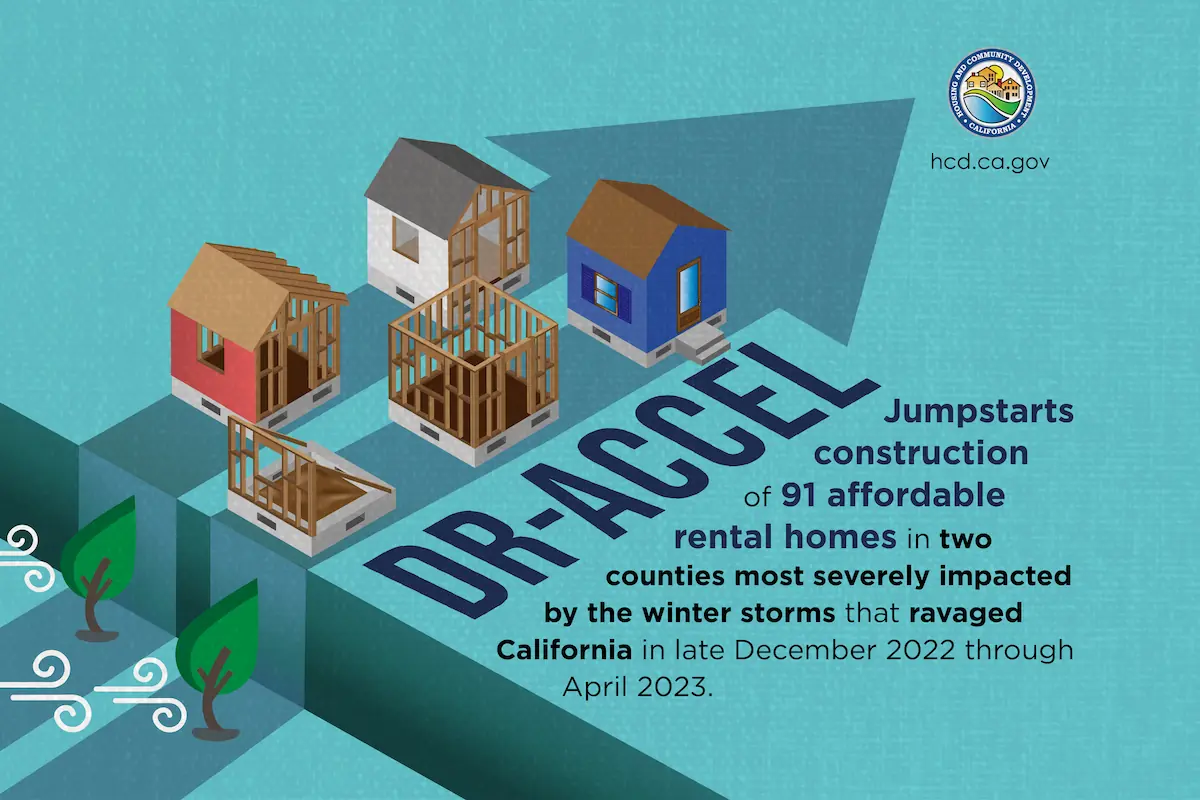
The California Department of Housing and Community Development (HCD) today announced two federal awards intended to jumpstart construction of 91 affordable rental homes in two of the counties most severely impacted by the winter storms that ravaged California in late December 2022 through April 2023.
Nearly $52.6 million has been awarded to two projects in Atascadero and Ojai through the federally funded Disaster Recovery Housing Accelerator Program (DR-ACCEL). Much like the state-funded California Housing Accelerator program, DR-ACCEL provides gap financing to help begin construction on shovel-ready projects that are stalled despite having received previous HCD awards, in this case due to an inability to secure anticipated tax credits, and supports disaster recovery efforts.
“The Multifamily Housing Accelerator Program is ensuring that the State of California can coordinate resources to residents who need it the most, when they need it the most,” said Tomiquia Moss, Secretary of the Business, Consumer Services and Housing Agency. “I’m looking forward to this continuing response with our federal partners. Thanks to this disaster relief funding, nearly 100 homes will be built for residents affected by the Winter Storms in San Luis Obispo and Ventura counties.”
“These projects demonstrate how state and federal funding programs can work in concert to help devastated communities recover and rebuild in the wake of natural disasters,” said HCD Director Gustavo Velasquez. “While delays can increase costs until a project is no longer feasible, we were able to keep these developments on track, bringing affordable new homes to two communities who so urgently need them.”
Recognizing unmet recovery needs from the floods that led to disaster declaration DR-4683 in areas already suffering from a critical shortage of affordable housing, HCD allocated $52,576,258 in federal 2020 Community Development Block Grant Disaster Recovery (CDBG-DR) funding to the DR-ACCEL program. Nine projects in counties deemed Most Impacted and Distressed from this disaster by the U.S. Department of Housing and Urban Development that had received HCD funding prior to December 31, 2023, were eligible to apply. Two applications were received requesting a total of $67.7 million, an oversubscription of 128 percent. These funds will accelerate two projects containing 91 units in the counties of San Luis Obispo and Ventura, putting them on track to begin construction within 180 days.
People’s Self-Help Housing Corporation was the highest-scoring applicant and received the full $34,049,563 requested to launch construction of the 42-unit Del Rio Ridge in San Luis Obispo County’s City of Atascadero. Del Rio Ridge addresses a critical gap in affordable housing in Atascadero by offering stable, service-enriched homes for large families and veterans who are experiencing or at risk of homelessness. The project will thoughtfully transform a steep, underutilized hillside into a safe, walkable neighborhood that integrates seamlessly with the surrounding residential area. The project lies within the City’s Del Rio Road Commercial Area Specific Plan, a growing corridor that includes a newly constructed grocery store and an upcoming RV park and motel, positioning Del Rio Ridge to contribute meaningfully to a broader neighborhood revitalization effort. The project previously received $1,758,900 million from HCD’s Veterans Housing and Homelessness Prevention Program.
Cabrillo Economic Development Corporation (Cabrillo) was awarded $18,526,695—the balance of the DR-ACCEL solicitation—to construct the 49-unit Camino de Salud in the City of Ojai in Ventura County. Camino de Salud is crucial to the community because it directly addresses the urgent housing needs of individuals experiencing or at risk of homelessness and those who are considered high-cost health users. Uniquely located in the Ojai Valley—a region constrained by limited infrastructure and zoning capacity— Camino de Salud is situated in a high-resource area. The project integrates deeply affordable and permanent supportive housing with on-site services; provides access to nearby amenities; and promotes long-term health, stability, and dignity for its residents. Camino de Salud was previously awarded $15,080,607 through 2018 CDBG-DR; $3,546,190 from the National Housing Trust Fund; and $7,680,000 from the Housing for a Healthy California program. Cabrillo identified the additional resources needed to bring this project to fruition.
Visit the HCD website for more information on the CDBG DR-ACCEL program and the awards announced today.
August 19, 2025
Pablo Espinoza
Off
Deputy Director of Communications
Article
California Announces $144.5 Million in Federal Awards to Build Multi-Family Rental and Single-Family Homes and Support Local Housing Assistance Programs
Off
Sacramento, CA

The California Department of Housing and Community Development (HCD) today announced more than $144.5 million in awards from the federally-funded HOME Investment Partnerships Program (HOME) to increase the supply of affordable single and multi-family housing in California and support local programs that provide housing assistance. The combined awards are expected to assist 984 California households through rental assistance, new construction of multifamily homes, and first-time homebuyer opportunities.
The HOME program is funded by the U.S. Department of Housing and Urban Development (HUD). Today’s awards highlight the crucial role of federal funding in expanding upon state investments to address pressing housing challenges and deliver long-term housing solutions. Continued federal and state partnerships will ensure individuals and families across the nation receive the assistance and resources they need.
“Everyone needs an affordable place to call home,” said Tomiquia Moss, Secretary of the Business, Consumer Services and Housing Agency. “These funds will help keep homes affordable, through rental assistance, new multifamily construction and first-time homebuyers opportunities.”
HOME has two distinct activities administered by HCD. The HOME Project Activities include grants to cities, counties and tribal entities and loans to developers and nonprofit Community Housing Development Corporations to build new affordable rental and homeownership housing and rehabilitate multi-family rental housing. The HOME Program Activities include grants to cities, counties, and tribal entities to operate local housing assistance programs that provide: First-Time Home Buyer (FTHB) down-payment assistance; Owner-Occupied Rehabilitation and Reconstruction (OOR) assistance to help homeowners make necessary health and safety and code compliance repairs to their primary residence; and Tenant-Based Rental Assistance (TBRA) to help eligible renters reduce their housing expense burden. The HCD HOME program is focused on small communities and rural areas of the state that do not receive HOME funding directly from HUD.
“These HOME awards demonstrate the Newsom administration's commitment to changing lives and strengthening rural economies. Today's announcement in partnership with HUD will open the door to first-time homebuyers, making the dream of stable homeownership a reality for families throughout California” said HCD Director Gustavo Velasquez. “The awards also highlight the importance of sustained federal funding to deliver much needed housing stability and important resources to those most at need.”
HOME awarded 14 Project Activities totaling more than $134.5 million to fund 643 HOME-assisted units in 13 California counties from Del Norte to Imperial. While the vast majority were multi-family new construction projects, the total did include one $3.1 million FTHB project in Fresno County to be developed by Self-Help Enterprises. Forty-seven applications requesting $422 million were received, demonstrating overwhelming statewide need for such assistance.
HOME also awarded 15 Program Activities totaling $10.5 million to grantees in 12 California counties—also spanning the length of the state—to aid approximately 341 households. This total includes more than $4.6 million in TBRA, $3.7 million in FTHB down-payment assistance, and $1.7 million for OOR programs. Unlike HOME Project Activities, Program Activities applications were undersubscribed by over $37 million, with the remaining funds reallocated to fund Multi-Family Project Activities.
Visit the HCD website for more information on HOME programs and the awards announced today.
August 15, 2025
Pablo Espinoza
Off
Deputy Director of Communications
Article
REAP Archive
Final NOFA and Guidelines
- REAP 2.0 NOFA and Final Guidelines for MPO Applicants (PDF)
- REAP 2.0 NOFA and Final Guidelines for Rural and Tribal Applicants (PDF)
- REAP 2.0 NOFA and Final Guidelines for HIT Allocation (PDF)
Draft Guidelines and Framework Paper
Timeline
| Activity | Description | Timing |
|---|---|---|
| Collaboration Design and Kick Off | Convening of state agency collaborative, early discussion of program parameters and staffing. | Summer 2021 |
| Framework Paper | Initial concepts and survey for broad stakeholder input. | November 2021 |
| Advance Application Available ("Formula Allocations for MPOs and COGs") | Up to 10% of program funds can be requested by eligible entities under the “Formula Allocations for MPOs and COGs”. |
Awards
REAP 2.0 Metropolitan Planning Organization (MPO) Awards
$480,000,000 in non-competitive funding is available to the state’s Metropolitan Planning Organizations (MPOs) for planning and implementation activities that support REAP 2.0’s goals and objectives.
Regional Early Action Planning (REAP) Grants of 2021
The Regional Early Action Planning Grants of 2021 (REAP 2.0) are a key part of the state’s strategic investments toward a more sustainable, resilient, and inclusive future.
Top