
July 2024

California Recognizes Three Prohousing Cities for Working to Dismantle Barriers to Housing Development
Off
Sacramento, CA
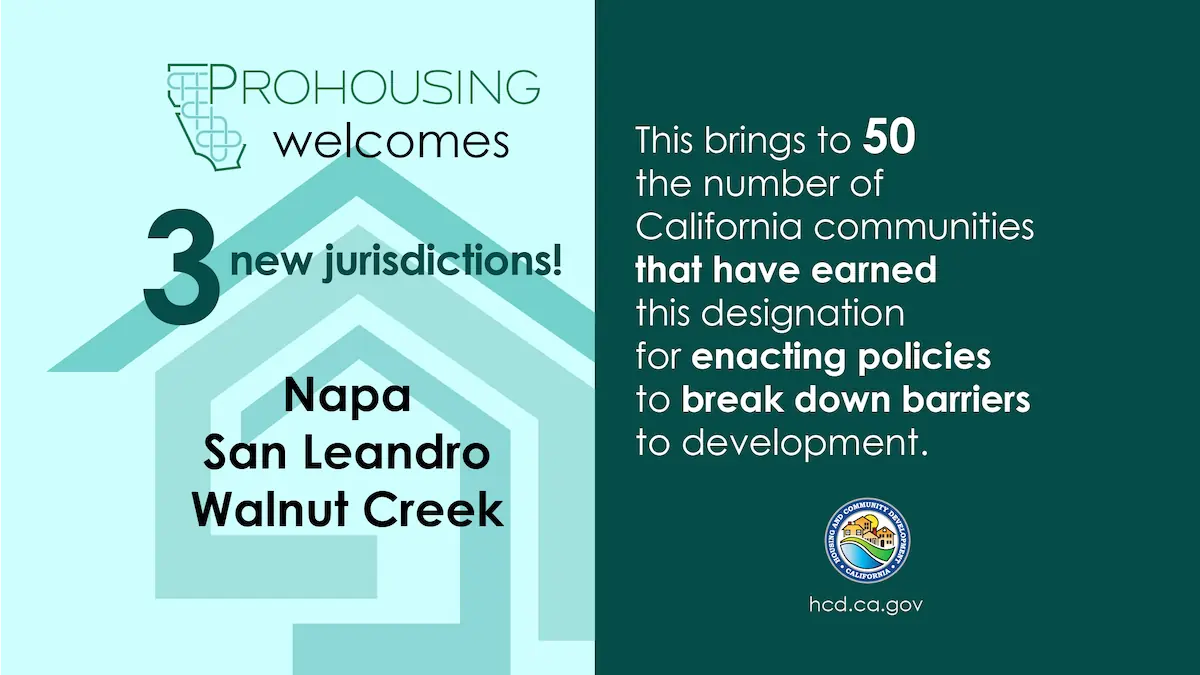
graphic of house with text Prohousing: napa, San Leandro and Walnut Creek. this brings to welcomes 3 new jurisdictions.  this brings to 50 the number of Califonria communities that have earned this designation for enacting policies to break down barriers to development.

The California Department of Housing and Community Development (HCD) today announced Napa, San Leandro, and Walnut Creek as the three most recent cities to earn the coveted Prohousing Designation. The Department also announced nearly $15.3 million in incentives to help 19 previously recognized Prohousing communities scale up their efforts to promote development of housing at all income levels.

The Prohousing Designation Program (PDP) administered by HCD recognizes cities and counties that demonstrate a commitment to enacting proactive policy changes and providing incentives and support to break down barriers to housing development. By earning the Prohousing Designation, communities receive exclusive access to Prohousing Incentive Program (PIP) grants and additional points in the scoring of competitive housing, community development, and infrastructure funding programs administered by HCD. Fifty California communities have now earned this distinction.

“I am thrilled to see the commitment to breaking down barriers to housing from all of these Prohousing cities up and down our state,” said Business, Consumer Services, and Housing Agency Secretary Tomiquia Moss. “I applaud these cities for their hard work and dedication to ensuring all members of our communities can achieve greater housing stability and, with it, more opportunities to succeed and thrive.”

“It is so encouraging to me to see 50 communities have put in the work to earn the title of ‘Prohousing,’ and that many others are working to establish policies and practices that expedite the approval and creation of housing faster and at the adequate scale,” said HCD Director Gustavo Velasquez. “It will take the concerted effort of forward-thinking community leaders to address housing need at all incomes levels today and into the future.”

In its Prohousing application, the City of Napa highlighted several innovative programs to help generate new housing and streamline affordable developments. As part of their work with the ADU Center of Napa and Sonoma, the city provides property owners with easy access to dozens of low-cost, off-the-shelf, pre-approved accessory dwelling unit (ADU) plans, saving thousands of dollars and months of time over a custom design. The city also manages a “Rental and Owner Occupied” rehabilitation program that provides grants and loans to help low-income households remain in their current homes and avoid displacement. Similarly, the city has established both an Affordable Housing Trust Fund and a 1% Transient Occupancy Tax (TOT) Fund specifically for supporting the development of affordable housing. TOT funds have a demonstrated history of affirmatively furthering fair housing, and Napa is one of the first cities to implement this innovative funding mechanism.

The City of San Leandro developed a Priority Development Area to allow for higher densities and greater floor area ratios and to remove height limits for infill housing near transit, resulting in an additional 2,500 homes. In addition, most housing projects are now subject to ministerial review without discretionary public hearings, accounting for a reduction of 9-12 months for entitlement of applications. The city has used modular construction for 200 affordable homes, utilizing prefabricated and inspected units that are assembled on site. Construction timelines were reduced by 40-50 percent, saving developers 15-20 percent in costs. Finally, the city has utilized $7.4 million in redevelopment agency housing loan repayments to subsidize operating and construction costs for 214 housing developments.

The City of Walnut Creek’s PDP application demonstrates a commitment to accelerating affordable housing development. The city adopted the Community Benefits program, which provides opportunities for developers to receive additional height limits, greater floor area ratio, and density bonuses for a project in exchange for providing amenities desired by the city and greater development intensity. In the past five years, the city has approved many residential projects that utilized statutory and categorical exemptions as authorized by applicable law, which has allowed for greater unit outcomes. Finally, the city utilizes local funding sources sufficient to facilitate and support the development of housing for lower-income households. It has adopted ordinances on commercial linkage and housing in-lieu fees that are allocated for affordable housing development.

Due to the flexible nature of PIP awards, local governments can use PIP funding to expand their own prohousing programs, preserve existing affordable housing within their jurisdictions, bridge financial gaps for affordable housing projects, or even pay operating costs associated with running permanent supportive housing programs such as Homekey, No Place Like Home, or the new housing investments made possible through voter approval of Proposition 1.

The cities approved for Round 2 PIP awards are:

  • Berkeley – $1,250,000
  • Brea – $660,000
  • Citrus Heights – $960,000
  • Crescent City – $650,000
  • Eureka – $630,000)
  • Fairfield – $774,253
  • Fontana – $1,090,000
  • Healdsburg – $560,000
  • Mountain View – $870,000
  • Petaluma – $840,000
  • Pinole – $650,000
  • Rohnert Park – $670,000
  • Rancho Cucamonga – $1,150,000
  • San Luis Obispo – $750,000
  • Santa Cruz – $500,000
  • Santa Monica – $1,000,000
  • South Lake Tahoe – $620,000
  • South San Francisco – $890,000
  • West Hollywood – $750,000

Visit HCD's website to learn more about the Prohousing Designation Program and the Prohousing Investment Program.

  • Press Release
  • Prohousing
  • August 1, 2024
    Nineteen Prohousing Communities Receive Share of $15.3 Million in Incentive Grants to Scale up Efforts to Meet Housing Needs of Residents at All Income Levels
    Pablo Espinoza
    Off
    HCD Media
    Deputy Director of Communications
    Article

    California Funds Capital Improvements to Support More Than 1,600 New Infill Homes in Small Jurisdictions

    Off
    Sacramento, CA
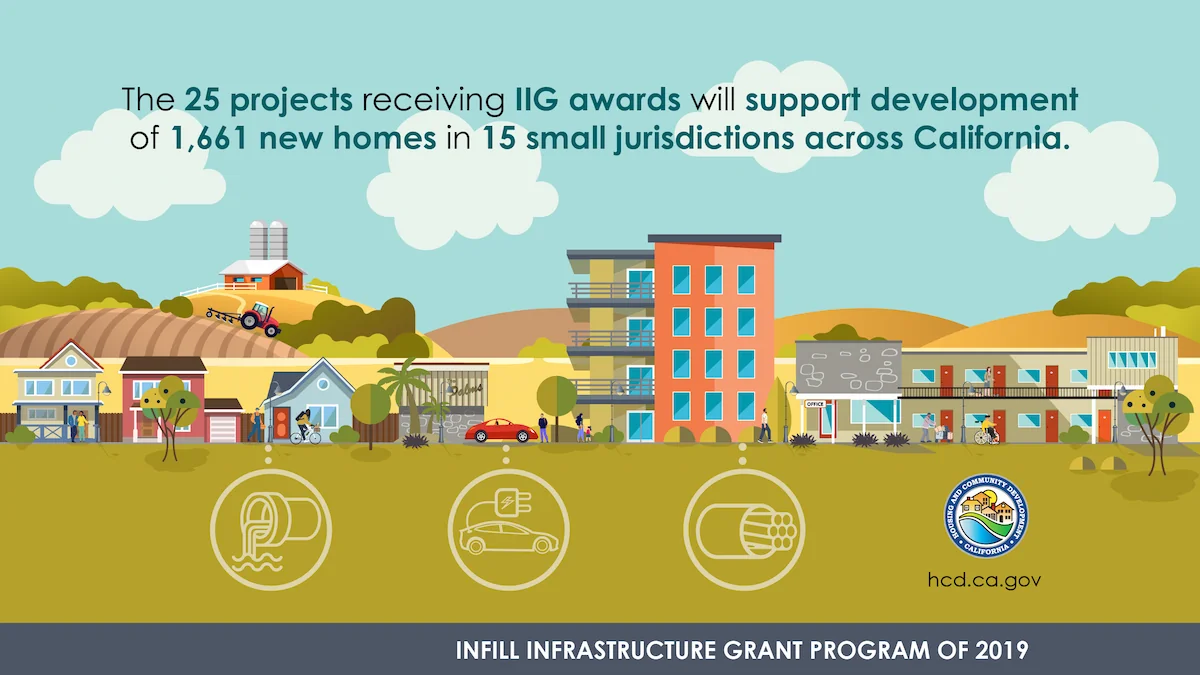
    Graphic scene of a city in a rural setting. Text reads: The 25 projects receiving IIG awards will support development of 1,661 new homes in 15 small jurisdictions across California.

    The California Department of Housing and Community Development today announced Infill Infrastructure Grant Program of 2019 (IIG) awards to 25 projects that will support development of 1,661 new homes in 15 California counties.

    “Empty lots and vacant buildings in cities throughout our state could be transformed into much-needed housing; Californians literally cannot afford for us to ignore these opportunities,” said California Governor Gavin Newsom. “Today, we’re providing tens of millions of dollars to California communities to begin building new homes on infill properties.”

    Today’s awards are being made from a set-aside in the NOFA for qualifying infill projects in “small jurisdictions”—those California counties with a population of 250,000 or less. IIG promotes infill housing development by providing gap financing in the form of grants for capital improvements needed to make residential or mixed-use development possible in urbanized areas. Project types include: sewer pipelines; traffic mitigation; curbs, gutters, and sidewalks; playgrounds and urban greening; pedestrian and bicycle trails and lighting; potable water systems and stormwater retention systems.

    “These investments in vital infrastructure improvements will jump-start housing construction to serve households most in need,” said Business, Consumer Services and Housing Agency Secretary Tomiquia Moss. “Through these improvements we can reduce our carbon emissions and increase the availability of housing more quickly and efficiently, removing barriers to the development and preservation of smart, climate-friendly housing near jobs, transit, and key neighborhood amenities.”

    “You cannot expand housing without building out infrastructure that supports such growth,” said HCD Director Gustavo Velasquez. “These awards help smaller counties meet the housing needs of residents without overburdening roads and utility systems and build healthy, sustainable communities connected to safe and inviting outdoor spaces.”

    The grants awarded today will support capital improvement projects in the following California counties with populations of less than 250,000 people: Butte, Colusa, Del Norte, El Dorado, Humboldt, Kings, Imperial, Madera, San Benito, Shasta, Sutter, Tehama, Tuolumne, Yolo, and Yuba.

    Unlike the competitive NOFA process for large jurisdictions, small jurisdiction IIG awards are made through an over-the-counter process, where applications are reviewed on a first-come, first-served basis and awarded if they pass the eligibility threshold while funds remain.

    HCD received 32 applications for nearly $97.8 million from the $94.2 million 2023 IIG Small Jurisdiction NOFA, an oversubscription of $3.6 million.

    Visit HCD online to learn more about the Infill Infrastructure Grant Program and the projects awarded today.

  • Press Release
  • July 31, 2024
    Pablo Espinoza
    Off
    HCD Media
    Deputy Director of Communications
    Article

    Housing Accountability Unit’s Efforts Lead to San Francisco’s Progress in Removing Barriers to Housing Production

    Off
    San Francisco Housing Policy and Practice Review report cover featuring photo of Golden Gate Bridge and City of San Francisco.

    In response to last year’s release of the California Department of Housing and Community Development’s (HCD) San Francisco Housing Policy and Practice Review (PDF) (PPR), San Francisco has implemented significant reforms that will make it easier to build housing at all income levels.

    The PPR – a first of its kind investigation into a local government’s barriers to housing production – required San Francisco to implement 18 required actions beginning immediately and through 2026 that resolve inconsistencies with state law, accelerate housing production, and reduce barriers beyond the strong commitments already being made through San Francisco’s 6th Cycle Housing Element.

    Since the release of the PPR, HCD has continuously monitored San Francisco's progress. As a result of this technical assistance from HCD and San Francisco's actions, they are currently up to date on required actions and, in some cases, implementing actions ahead of schedule. The PPR accelerated the passage of reforms already underway and supported the early completion of several actions proposed in San Francisco’s Housing Element.

    These policy and practice changes can now begin to translate into real impact and results for development in San Francisco.

    Some of the most significant reforms San Francisco has made to address their required actions include:

    • Approving the Constraints Reduction Ordinance – The Constraints Reduction Ordinance was proposed shortly after the adoption of the Housing Element and signed into law on December 14, 2023, following technical assistance from HCD. The Ordinance fully or partially implements numerous housing element commitments, including reducing the need for Planning Commission hearings for certain code-compliant projects; allowing group homes throughout San Francisco, including within single family-zoned neighborhoods; modifying development standards such as lot size, lot width, and open space to reduce complexity in achieving compliance with zoning code requirements; and reducing notification requirements outside of Priority Equity Geographies for qualifying projects that provide net new housing. (See PPR Required Action 1.10.)
    • Reforming CEQA processes to give a clear determination within 30 days of a complete application – San Francisco has modified its internal environmental review procedures to ensure that project applications are given a clear CEQA exemption determination within 30 days of accepting an application as complete. This infographic describes the revised typical planning review workflow for a non-ministerial project, including the environmental review. (See PPR Required Action 2.1.)
    • Prohibiting subjectivity in planning approval – San Francisco has taken interim steps to remove the use of subjective criteria in reviewing housing projects for compliance. As San Francisco describes on its Planning Approval webpage, housing developments are no longer subject to any subjective or discretionary requirements found in applicable design guidelines, project analysis, and conditions of approval. (See PPR Required Actions 1.3, 1.4 and 1.9.) Future steps involve updating all documents to remove references to these subjective criteria.
    • Increasing objectivity and transparency, in the construction permitting process – The City’s Department of Building Inspection (DBI) has implemented key changes to bring greater consistency, transparency, and objectivity to the post-entitlement review process. This includes updates to the DBI website to outline and ensure availability of submittal requirements for post-entitlement permits in one centralized location, establishing new quality control systems, weekly building code trainings, an escalation process to resolve code interpretation issues, and updates to an internal staff Plan Review Manual. (See PPR Required Action 4.1.)
    • Restructuring processes so that developments that already received planning approval cannot be subject to subsequent building permit appeals – San Francisco separated out its planning and entitlement review process from the subsequent, post-entitlement building permit review process. This reform was key to properly implementing AB 1114 regarding post-entitlement review and ensures that qualifying projects which have already received planning approval cannot be subject to subsequent building permit appeals or additional hearing requirements. A summary of these changes can be found on the City's Planning Department, Department of Building Inspection (DBI), and building permit resubmission webpages. (See PPR Required Actions 3.1, 3.2, and 3.3.)
    • Reducing procedural hurdles for code-compliant projects – The Conditional Use Authorization (CUA) process has been a barrier to facilitating timely approvals for code-compliant projects where residential development is already allowed and has induced discretion where state housing law does not allow for it. Through the Constraints Reduction Ordinance, San Francisco eliminated the requirement to obtain CUA for most code-compliant housing project types within Well Resourced Neighborhoods. (See PPR Required Action 1.2.)
    • Removing hearing requirements for most State Density Bonus Law (SDBL) requests – Through the Constraints Reduction Ordinance and subsequent Planning Commission resolution, San Francisco delegated authority to the Planning Director to review most projects under the SDBL without the need for a hearing. In addition, San Francisco has changed how it applies local inclusionary housing requirements to projects using SDBL. This included revisions to San Francisco’s implementation bulletin. (See PPR Required Actions 1.7 and 1.8.)

    Together, these actions help cut red tape and uncertainty, clarify opaque processes, and ensure compliance with state housing laws.

    These changes represent important steps in the right direction and reflect a commitment to achieving a new status quo in San Francisco. Nevertheless, to ensure full implementation of the actions in both the PPR and the housing element – and to achieve housing production in San Francisco that truly meets the need – HCD will continue to provide ongoing support and monitor San Francisco’s progress on their 6 remaining PPR actions as they come due. The actions that San Francisco must still implement include the following:

    • Revise entitlement processes to require that housing developments that conform to existing planning and zoning standards move efficiently through a non-discretionary, ministerial entitlement process. (See PPR Required Action 1.1, due Fall 2026.)
    • Revise the Residential Design Guidelines and Urban Design Guidelines to remove all subjective standards and requirements. (See PPR Required Action 1.3, due October 2024.)
    • Eliminate the use of “neighborhood character” and “neighborhood compatibility” terminology in relevant design guidelines. (See PPR Required Action 1.4, due October 2024.)
    • Revise the Large Project Authorization in Eastern Neighborhoods and the Downtown Large Project Authorization processes to ensure approval criteria for housing projects are written and objective. (See PPR Required Action 1.9, due October 2024.)
    • Eliminate additional requirements for supplemental environmental review not required by CEQA, such as shadow and wind studies. (See PPR Required Action 2.2, with an evaluation due October 2024 and changes due October 2026.)
    • Reduce constraints on affordable housing developments, including removing public art requirements. (See PPR Action 4.2, due October 2024.)

    By staying on track with these remaining items, San Francisco will continue to demonstrate its commitment to facilitating housing production at all income levels and ensure compliance with its obligations.

  • Accountability
  • August 2, 2024
    San Francisco Has Implemented Key Actions Required by HCD’s Housing Policy and Practice Review
    Off
    Article

    San Diego Welcomes New Affordable Housing Community for Seniors

    Off
    San Diego, CA
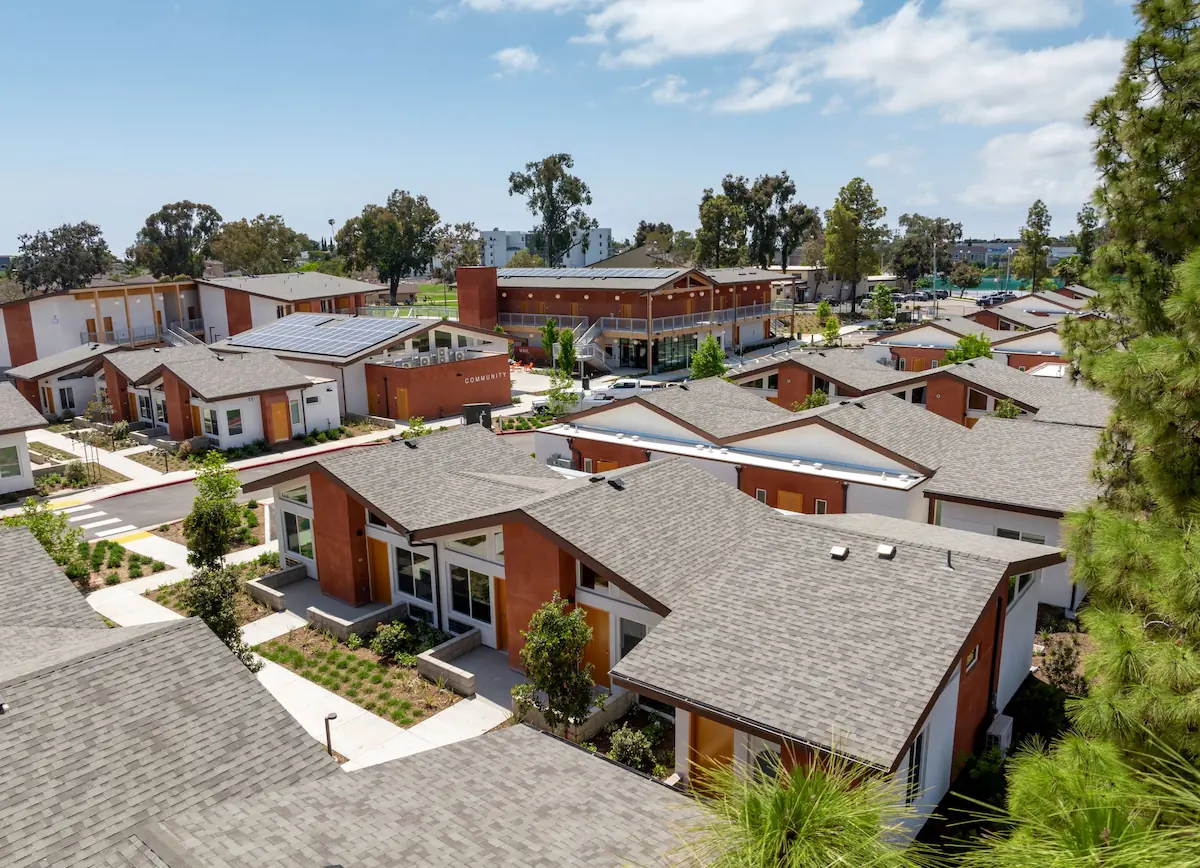
    Levant Senior Cottages Complex

    There is a new addition to San Diego’s affordable housing community! Levant Senior Cottages, an affordable housing development for adults aged 55+ who earn 25-50 percent of Area Median Income, recently celebrated its Grand Opening in Linda Vista.

    This 127-unit new construction project is the first affordable housing project in San Diego built on excess county land, offered for the sole purpose of developing more affordable housing. Built by Wakeland Housing and Development Corporation, in partnership with San Diego Kind, Levant is a shining example of what local governments can accomplish for their most vulnerable residents.

    “As the nation continues to face an unprecedented housing crisis, California is leading the way in delivering innovative programs that support and protect our most vulnerable residents while creating long term affordable housing,” said Melissa Harty-Swaleh, a manager with the California Department of Housing and Community Development (HCD). “Levant Senior Cottages is bringing much-needed homes to San Diego seniors.”

    Residents of Levant will enjoy onsite services and social activities, as well as wrap-around medical and social services for PACE program members, offered by St. Paul’s PACE. Of the 127 units in this development, 32 are restricted to Special Needs Populations through HCD’s Multifamily Housing Program, which provided $19 million in funding for this development.

    On-site amenities include a community room with kitchen, a computer room, high-speed internet throughout the complex, a fitness room, and a picnic area. Levant Senior Cottages is close to the public library, a recreation center, local area parks, and shopping centers.

  • Affordable Housing
  • Success Stories
  • July 29, 2024
    Off
    Article

    Shasta County Celebrates New Affordable Housing After Carr Fire

    Off
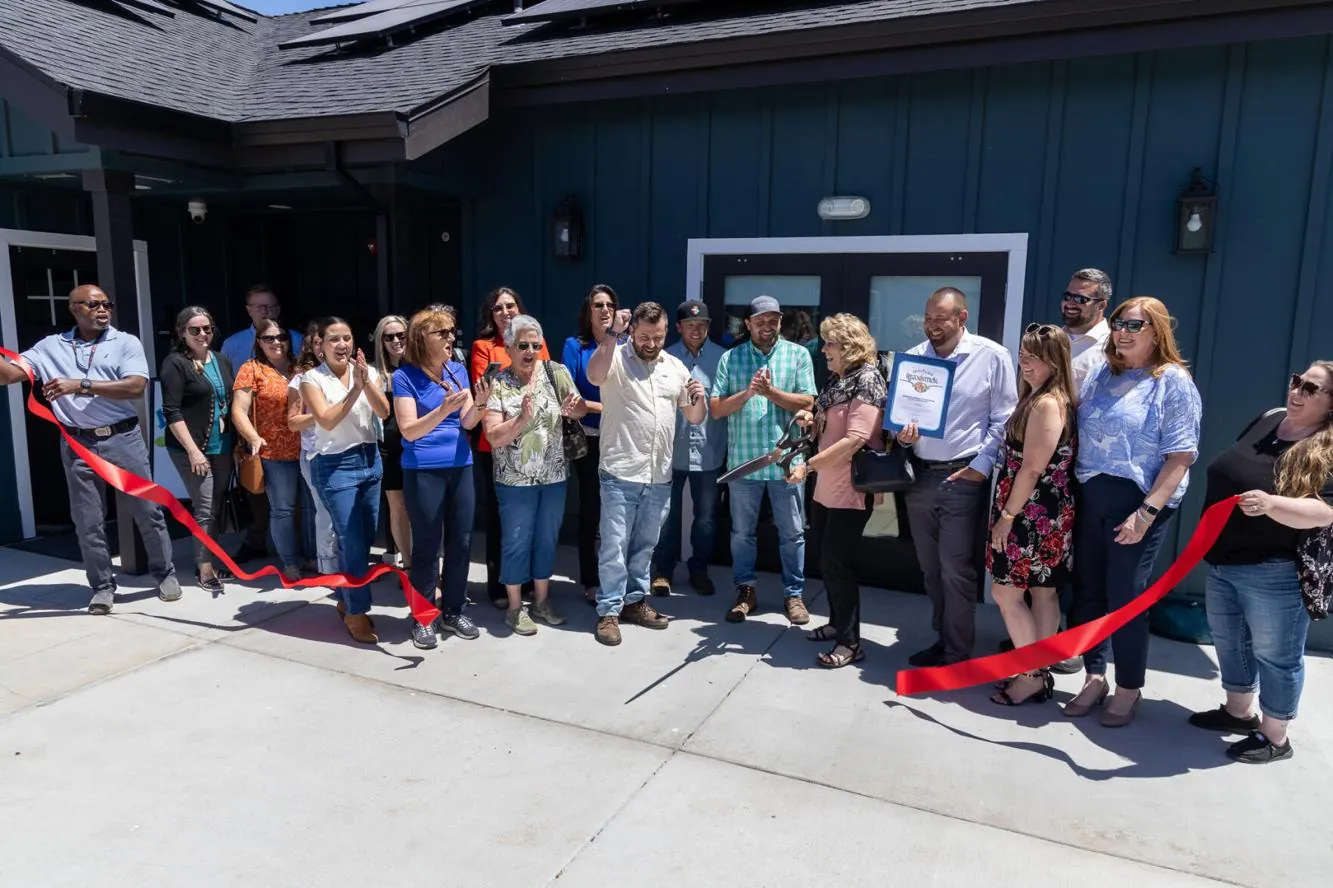
    Ribbon-cutting ceremony.

    In 2018, the County of Shasta was devastated by the Carr Fire. With an estimated 1,614 structures destroyed, the community is still working to rebuild.

    Shasta County recently had cause to celebrate at the ribbon cutting for Burney Commons, a new affordable housing development in Burney, CA, that provides 30 affordable homes for individuals and families earning up to 50 percent of Area Median Income.

    Burney Commons has solar paneling and is designed for energy efficiency. The complex has an on-site community room, laundry facilities, and outdoor spaces and is located near businesses and vital amenities and services.

    The housing development was supported by more than $14 million from HCD’s Community Development Block Grant Disaster Recovery Multifamily Housing Program (DR-MHP). Working with local governments and developers in areas impacted by federally declared natural disasters, HCD’s DR-MHP program helps communities build multifamily housing projects and generate crucial affordable homes. This is the first DR-MHP project to finish construction in the County of Shasta.

    Learn more about HCD’s Disaster Recovery programs through a series of videos on our website or on YouTube.

  • Disaster Recovery
  • Success Stories
  • July 24, 2024
    Off
    Article

    New Affordable Housing Opens in San Jose

    Off
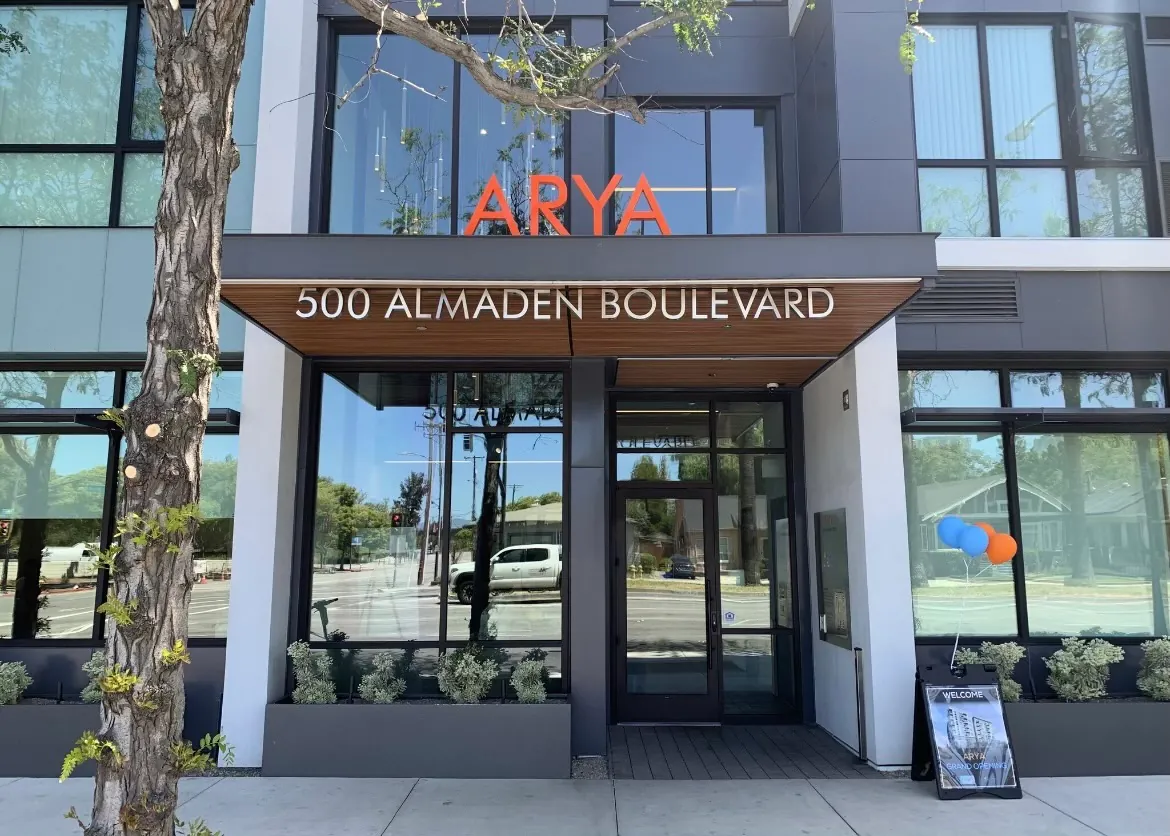
    Arya apartment complex.

    The City of San Jose has a new affordable housing complex on Almaden Boulevard! Arya, formerly known as San Jose Market, is now open and provides 87 much-needed affordable homes for the Silicon Valley.

    Arya serves very low-income residents earning 30-60 percent of Area Median Income. The development is supported by more than $12.7 million from the Affordable Housing and Sustainable Communities program, which is jointly administered by HCD and the Strategic Growth Council. This eight-story project was developed by Satellite Affordable Housing Associates and is their first project in San Jose.

    HCD also awarded Arya more than $3.5 million from the Infill Infrastructure Grant program, providing the funding necessary to improve infrastructure and create a safe and sustainable environment for residents. This Capital Improvement Project included sanitary sewer, potable water, and joint trench costs for utilities; 40 parking spaces in a podium garage; 44 bicycle parking spaces; demolition of an existing parking lot; grading and erosion/weed control; sidewalk improvements including replacing sidewalk, curb, and gutter; and hazardous materials mitigation measures requiring a grade-level vapor barrier.

    Today, Arya residents can enjoy a beautiful terrace garden, free wireless internet throughout the building, and a community room for get-togethers and events. Arya is located close to many amenities and is within walking distance of public transit in Downtown San Jose.

  • Affordable Housing
  • Success Stories
  • July 23, 2024
    Off
    Article

    Large Transit-Oriented Housing Complex in Santa Cruz Breaks Ground

    Off
    Santa Cruz, CA
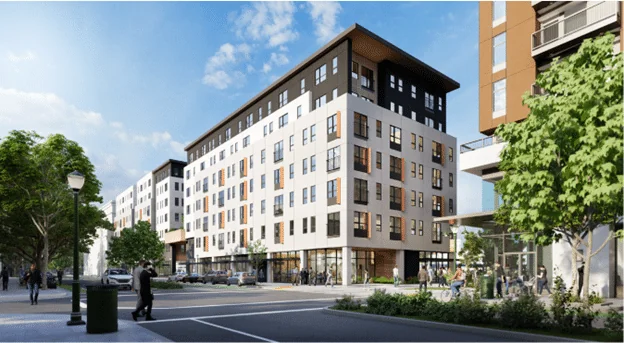
    Rendering of Pacific North Apartments

    The Santa Cruz community has broken ground on a new affordable housing complex. Pacific Station North Apartments – developed by Eden Housing in partnership with For the Future Housing, Inc. – will be a 128-unit affordable housing development in the heart of downtown. With a planned ground floor retail and commercial space, this seven-story project will set aside 32 units for extremely low-income households and 21 units for individuals and families who are homeless or at risk of homelessness.

    This development marks the final phase of Pacific Station, a massive transit-oriented redevelopment in downtown Santa Cruz. Residents of Pacific Station North will have on-site access to a computer lab, a community center, a communal laundry facility, and an after-school program for their children. Wi-Fi will be installed in all community spaces.

    Replacing the former METRO bus station, the development site required multiple infrastructure improvements before a groundbreaking could take place. These improvements included new traffic signals, stormwater management installation, bike lanes, lighting, bus turn lanes, and the demolition of previous buildings. Funding for this part of the project was provided in part by a $5.8 million Infill Infrastructure Grant from the California Department of Housing and Community Development (HCD), as well as another $20 million from the Affordable Housing and Sustainable Communities (AHSC) program administered jointly by HCD and the Strategic Growth Council.

    When completed, Pacific Station North will be a net-zero carbon emission structure, providing affordable housing, a new METRO bus transit hub, a pedestrian paseo, and retail space for the city.

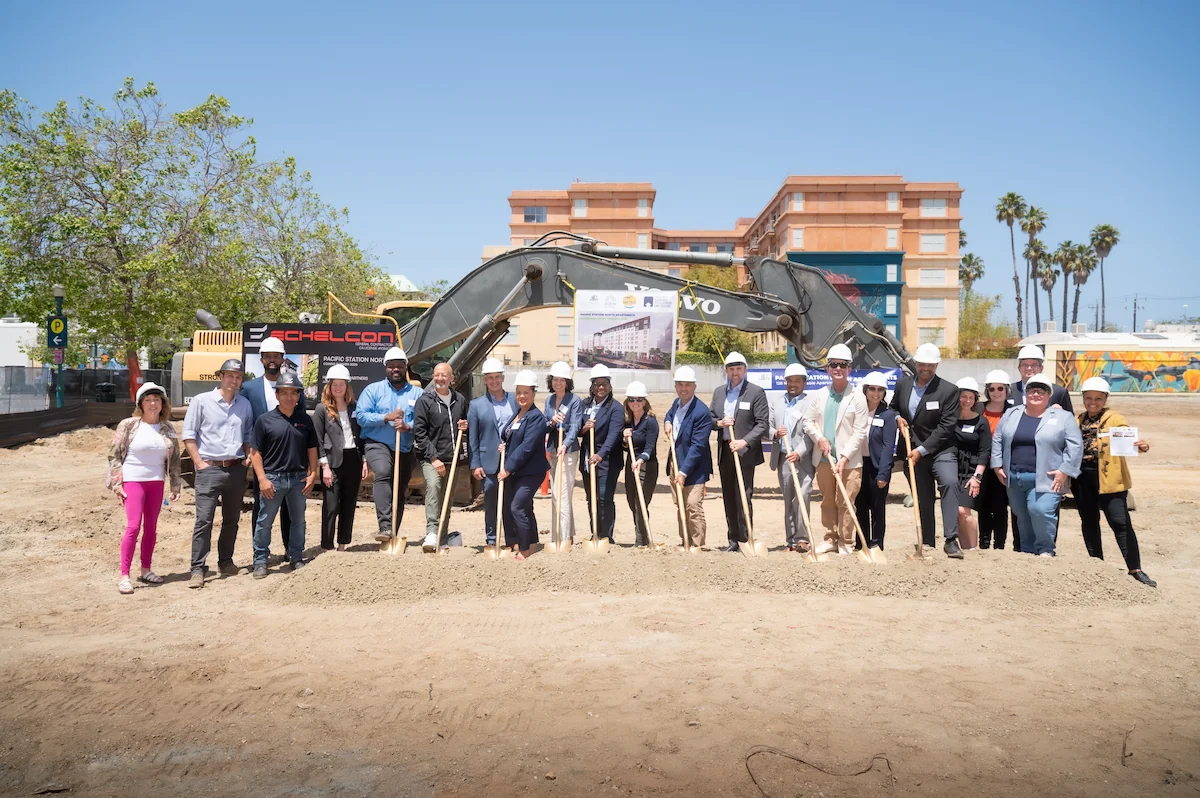
    Groundbreaking ceremony for Pacific North Apartments

  • Affordable Housing
  • Success Stories
  • July 19, 2024
    Off
    Article

    HCD Staff Tour Manufactured Home Factory in Sacramento

    Off
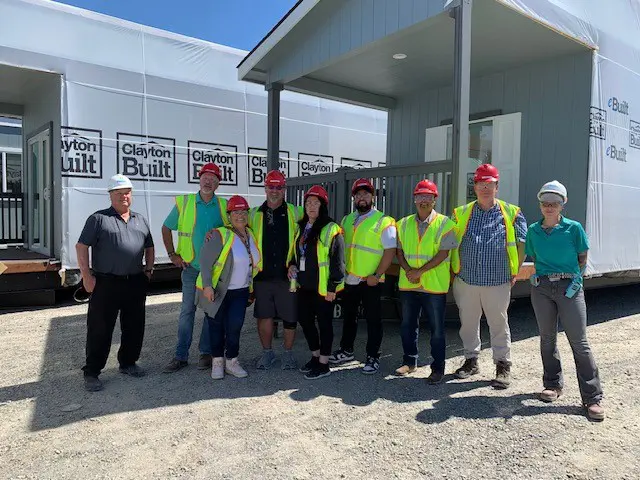
    HCD staff posed in front of manufactured home during tour.

    Manufactured homes are an important source of affordable housing and homeownership in California. Manufactured homes, previously known as mobilehomes, are manufactured in a factory setting. Unlike homes that are built from the ground up, these homes are built off-site, transported in one or more sections, and assembled on-site on a permanent chassis or frame.

    The Department of Housing and Community Development (HCD) ensures the safety and health of consumers by enforcing regulations for those who manufacture and sell manufactured homes. Recently, HCD staff were given a tour of the Clayton Home factory in Sacramento to further staff’s education on the manufacturing process. Staff were introduced to processes including raw building of the steel chassis, construction of walls, electrical and plumbing layout, roof assembly, and final steps for issuance of an insignia from the U.S. Department of Housing and Urban Development (HUD).

    HCD’s Manufactured Housing program administers the construction and alteration of manufactured homes, commercial modulars, special purpose commercial modulars, and multifamily manufactured homes, monitoring design and construction through third-party agencies. Additionally, this program performs activities on behalf of HUD as a State Administrative Agency (SAA) and conducts annual monitoring of all manufacturers located in California. 

  • Affordable Housing
  • July 12, 2024
    Off
    Article

    Rebuilding for the Future

    Off
    Paradise, CA
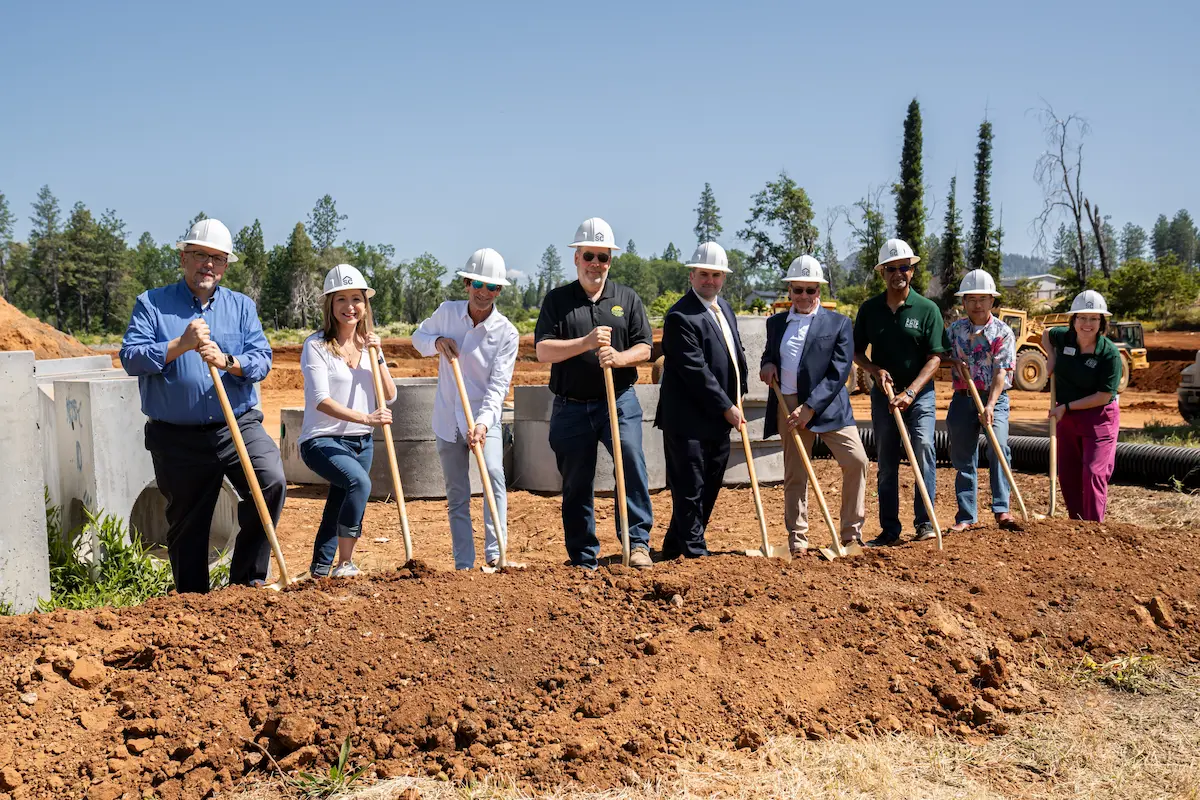
    People holding ceremonial shovels at groundbreaking ceremony.

    HCD recently joined in celebrating the groundbreaking of Cypress Family Apartments, a new 70-unit affordable housing project in Paradise, California.

    Specifically designed for large family households earning from 30-60 percent of the Area Median Income, the Cypress Family and Senior Apartments development has been a dream for many. A project of the Community Housing Improvement Program (CHIP), Mercy Housing, and Zen Development Consultants LLC, this multi-building complex is part of a much larger 24-acre plan incorporating senior housing a community center, two playgrounds, laundry facilities, a dog park, a community garden, and a central green.

    Cypress Family Apartments is supported by more than $14 million in funds from HCD‘s Community Development Block Grant Disaster Recovery Multifamily Housing Program (DR-MHP). Working with local governments and developers in areas impacted by disasters, HCD’s DR-MHP helps communities build multifamily housing projects and generate crucial affordable housing units.

    “I have the wonderful privilege of thanking our amazing partners for doing hard things like rebuilding the community,” said CHIP President Seana O’Shaughnessy. “It takes persistence, creativity, and partnership.”

    The 2018 Camp Fire devastated Paradise, destroying nearly 14,000 homes. Today, Paradise continues to rebuild, creating a stronger infrastructure and more affordable housing options for its displaced and returning residents. HCD is honored to partner with both the Town of Paradise and Butte County in rebuilding a healthy community of opportunity for disaster survivors.

    Watch HCD’s Disaster Recovery video series to learn more about our disaster recovery programs and the communities they serve.

  • Disaster Recovery
  • Success Stories
  • July 8, 2024
    Off
    Article
    Top